
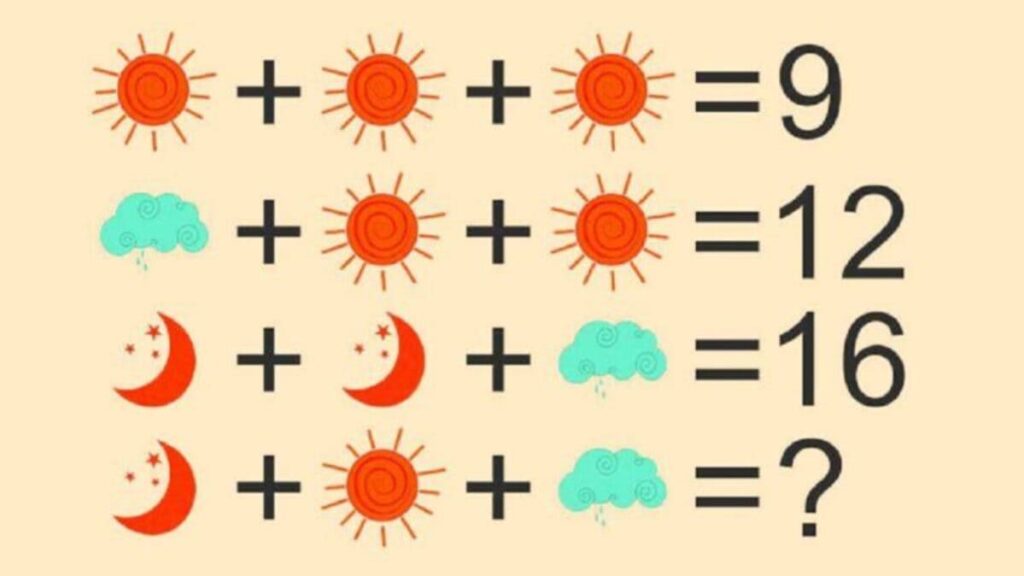
There’s something oddly reassuring about a seemingly straightforward puzzle that quietly undermines your confidence. This particular brain teaser has made its way through classrooms and living rooms, leaving many recent graduates scratching their heads in confusion. On the surface, it appears to be a riddle suitable for teens, but in reality, it challenges logical reasoning, pattern recognition, and composure under pressure. Before you race off to find the answer, take a moment to pause – you might just be more capable than you realise.
A riddle with a twist
Once in a while, a puzzle emerges that starkly reminds us of how much our school maths skills have deteriorated. This riddle presents three symbols – a sun, a cloud, and a moon – and invites you to assign numerical values to each. The objective is simple: determine their worth and add the values together. The catch? You need to solve it in under fifteen seconds, a point where many adults suddenly feel a wave of nostalgic panic wash over them.
Teachers often encourage students to engage with puzzles like this because they do more than challenge arithmetic skills. According to the UK’s National Numeracy charity, tasks that require reasoning and pattern recognition are strong indicators of a learner’s cognitive abilities, helping to identify both strengths and areas needing improvement. In other words, a quick symbol puzzle can shed light on how your brain functions in surprising ways.
What the riddle reveals about you
For some individuals, challenges like this can be exhilarating. They offer a rush of excitement when you spot the pattern just in time. For others, they gently highlight skills that may have been neglected since high school. Regardless, puzzles of this nature foster strategic thinking and enhance what educational psychologists describe as fluid intelligence.
If you tackle it with friends or family, you’ll quickly notice the differing approaches each person takes toward the same task. One person might dive headfirst into calculations, while another may take a moment to analyse the structure of the equations. This disparity is part of the allure – and the learning experience.
Solving the puzzle
The key to cracking the code lies in understanding the relationships between each symbol and the corresponding numbers. The sun acts as the anchor point; once you establish that it can’t be worth more than three, the rest of the pattern begins to unfurl. With this value, the cloud totals six, leaving the moon at five once the final equation is decoded.
The arithmetic itself isn’t overly complex. What makes the riddle so effective is its combination of speed and logic. Experts from the Mathematical Association point out that fast-paced puzzles activate reasoning processes akin to those used in more complex problem-solving, making them an excellent warm-up for learners across all age groups.
The final calculation
Once you’ve assigned the values – sun at 3, cloud at 6, and moon at 5 – it’s time to add them up. The total of these symbols is 14. Plug that number into the final equation, and you’ll arrive at a result of 46, a number that trips up more than half of those who attempt it under pressure.
The ongoing significance of puzzles
Even in an age dominated by calculators and instant online solutions, puzzles like this continue to provide a valuable exercise. They foster problem-solving habits, build confidence, and offer a quick yet meaningful brain workout. Whether you prefer tackling these challenges solo or turning them into a light-hearted competition, they remind us that intellectual play holds equal weight to formal study.
So, if you managed to solve it – well done! And if not, don’t fret; you’re in good company. After all, the best path to improvement is through persistent practice – preferably before someone hits that fifteen-second timer again.





