
It’s a peculiar thought: as we move through our daily routines above ground, a dedicated team of researchers is stationed nearly a mile beneath the Earth’s surface, attuned to the whispers of the universe. Shielded from light and sound, they’re on the hunt for something that remains elusive yet fundamentally influences our understanding of the cosmos. Dark matter is one of science’s toughest enigmas, and this underground project represents a significant stride towards unraveling its secrets.
Venturing into the Abyss
At the centre of this ambitious project is the LUX ZEPLIN detector, or LZ, nestled within the Sanford Underground Research Facility in South Dakota. Situated over 1,600 metres below the surface, this isolated setting is crucial for shielding the scientists from cosmic radiation. Here, silence becomes an invaluable scientific tool. Amidst this stillness, the researchers aim to detect fleeting signs of WIMPs—weakly interacting massive particles that are strong contenders for dark matter.
As experimental physicist Hugh Lippincott articulated, uncovering a new particle would be remarkable, but narrowing down the possibilities is equally important to clarify our understanding of the universe. Dark matter is thought to constitute the bulk of the universe’s mass, yet it ardently evades direct detection, influencing galaxies while concealing its true nature.
Illuminating Xenon’s Mysteries
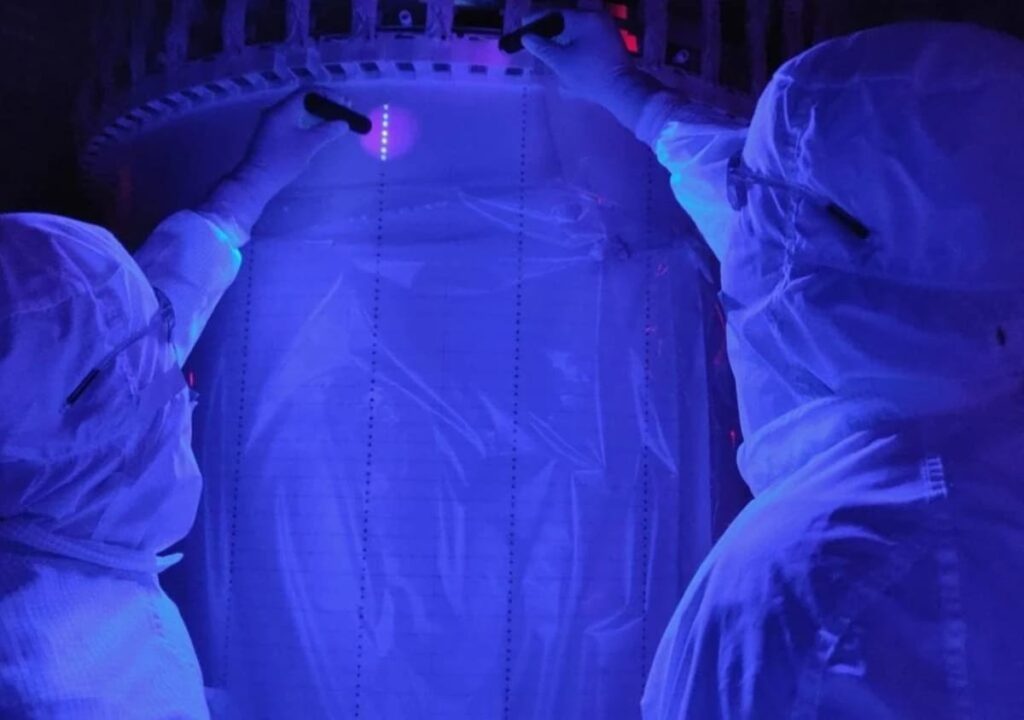
The core of the LZ detector features two titanium chambers filled with ten tonnes of ultrapure liquid xenon. When a particle grazes a xenon atom, even for an infinitesimal moment, it can generate a faint flash of light—an event that the detector is designed to identify. This chamber is encased within an outer detector that utilises a scintillating liquid enriched with gadolinium, enabling researchers to differentiate genuine signals from cosmic noise.
Recent analyses have revealed results from 280 days’ worth of collected data, with the team aiming to extend this to about a thousand days by 2028. In the serene world illuminated by xenon flashes, time is a precious commodity. Every additional day enhances the experiment’s sensitivity and eliminates more hypothetical models.
Why Bury a Lab Underground?
The remarkable sensitivity of LZ is intricately linked to its subterranean location. By placing the detector deep underground, researchers can mitigate interference from cosmic rays that strike the surface relentlessly. The materials used in the construction are deliberately selected for their low natural radioactivity, an almost quirky choice in any context outside of particle physics.
The UK’s Science and Technology Facilities Council emphasises that suppressing background noise is a paramount challenge in dark matter research. Each layer of shielding and every carefully calibrated sensor is essential to ensure any detected signal is authentic and not a terrestrial impostor.
Confronting Potential False Signals
Neutrons are one of the most troublesome culprits for generating false alarms. These neutral subatomic particles are practically ubiquitous and can produce signals that closely resemble those anticipated from WIMPs. To combat this, researchers designed the outer detector specifically to track neutrons and eliminate them from the data. As physicist Makayla Trask observes, discerning the real from the fraudulent is crucial for making credible detections.
Radon, a naturally occurring radioactive gas, also poses a challenge. Its decay chain may mimic the subtle signatures associated with dark matter. Luckily, the team has developed methods to identify these sequences and exclude them from the dataset to uphold the experiment’s integrity.
Ensuring Objectivity in Science
To prevent any biases during data interpretation, the collaboration employs a technique known as salting, where synthetic signals are integrated into the data as it is collected. Analysts remain unaware of which events are authentic until the review phase is complete and the data is “unsalted”. This method, employed by numerous significant physics collaborations, safeguards researchers from subconsciously steering results in a desired direction.
As study coordinator Scott Haselschwardt puts it, navigating an unexplored domain of physics demands a clear mind and stringent objectivity.
Homestretch Towards the Invisible
The latest findings are fine-tuning the range of potential WIMPs, systematically discarding incorrect models and guiding future experimental designs. Yet LZ transcends its role as a mere dark matter seeker; its sensitivity allows for the detection of solar neutrinos and rare radioactive decays, expanding the horizons of scientific inquiry.
With over 250 scientists from six countries in collaboration, there’s already talk of a successor: XLZD, a next-generation detector with even greater sensitivity. This mission into the depths of the unknown could be the key to finally identifying the elusive glue that binds the universe together.
Deep in a cavern a mile beneath our feet, the relentless search continues—patient, meticulous, and quietly optimistic.





