
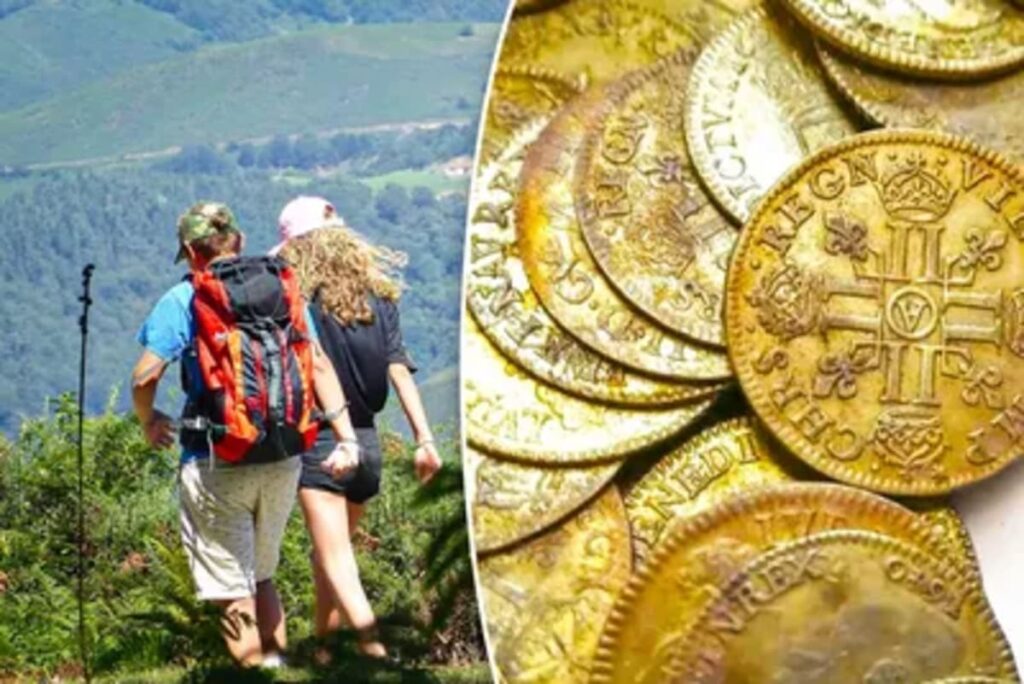
Occasionally, a remarkable discovery emerges, as if history is nudging us to pay attention. This was precisely the case in the Czech mountains, where two winter hikers stumbled upon a century-old treasure. Nestled within the earth were gold coins, personal belongings, and remnants of interrupted lives—meticulously concealed for generations. Finds like this not only captivate our imaginations but also prompt us to reflect on themes of anxiety, resilience, and survival during tumultuous times. This is the narrative of one of the Czech Republic’s most fascinating modern hoards.
Unearthing treasure in the Czech hills
On an ordinary winter’s day, two hikers seeking fresh air along the Zvičina slopes stopped near a dry stone wall. What lay behind a few loose stones turned their day into an extraordinary archaeological moment suitable for a museum exhibit. Inside two small containers—placed just a metre apart—they discovered 598 gold coins, neatly wrapped in dark fabric and stacked with care. The total cache weighed around seven kilos, with nearly four kilos comprised entirely of pure gold.
Alongside the coins were everyday items that felt almost personal in nature: a metal purse, a tobacco case, jewelry, a comb, and a delicate chain terminating in a small key. These artifacts, now preserved under secure conditions, sketch a picture of a life abruptly interrupted—an account of someone who hid away the belongings that mattered most.
An intriguing mix of coins
What makes this discovery particularly noteworthy is the unusual composition of the coins. The majority were French, followed by pieces from the former Austro-Hungarian Empire, Belgium, and the Ottoman domains. Yet notably absent were any German or Czechoslovak coins, a point of interest for numismatists in this region.
Some coins featured tiny countermarks that were added in the Balkans in the 1920s and 1930s, suggesting they had a far-reaching journey before their final concealment. According to museum specialist Vojtěch Brádle, this pattern indicates that the owner valued them not for their imagery but for their intrinsic worth, serving as a sort of private insurance during a time of significant uncertainty.
Gold as a bulwark amidst chaos
The early twentieth-century landscape of Central Europe was marked by shifting borders, political upheaval, and economic instability. In such turbulent times, burying gold was less a romantic gesture and more a pragmatic strategy for protection. Historians describe such deposits as material records of collective anxiety—evidence of families striving to safeguard their future during an era when traditional security systems felt fragile.
The presence of personal items adds a poignant dimension to this story. Rather than hoarding wealth for trade, this appears to be the rushed collection of precious possessions, perhaps in anticipation of impending displacement or an immediate threat. It serves as a quiet reminder that objects can simultaneously embody fear and hope.
Utilising advanced analysis for fragile treasures
To trace the origins of these artifacts, researchers are employing X-ray fluorescence spectroscopy—a non-destructive technique commonly used by conservation institutions like the British Museum. This method allows scientists to determine the chemical composition of metals without causing any damage, offering insights into purity, date, and sometimes even the original workshop. It will be applied not only to the coins but also to bracelets, tobacco cases, and other objects found in the hoard.
These details are significant; stylistic elements, alloy compositions, and microscopic inscriptions can help pinpoint ownership and construct a clearer narrative around how these items traversed borders before being hidden away.
Legally protected and meticulously studied
Under Czech heritage laws, such discoveries fall under public stewardship. The hikers who reported their find adhered to proper protocols and may be entitled to receive up to ten percent of the hoard’s assessed value, contingent on its rarity and cultural relevance. For the moment, each item is housed under controlled conditions as experts navigate the process of cataloging and analysis, prioritizing thorough study over rapid publicity.
When gold tells a story
Beyond its financial value, this hoard narrates a chapter from a forgotten history. The Balkans countermarks, the predominance of French coins, and the conspicuous absence of German currency all provide glimpses into trade dynamics, saving patterns, and the psychological climate of the interwar years. The region itself—shaped by political changes and population movements—adds another layer of significance to this discovery.
What is its worth today?
With gold prices exceeding four thousand dollars per ounce, the material value of this hoard could reach several hundred thousand euros. However, specialists often argue that its historical significance far surpasses its market price. In a climate marked by renewed skepticism towards financial institutions and inflationary challenges, the allure of ancient caches and hidden treasures continues to rise—a testament to the fact that, even today, people seek tangible security amid uncertainty.
The Czech treasure represents more than a fortunate find; it serves as a whisper from a tumultuous past and a reminder of how people throughout time have clung to protection, memory, and the flickering hope they can carry.





