
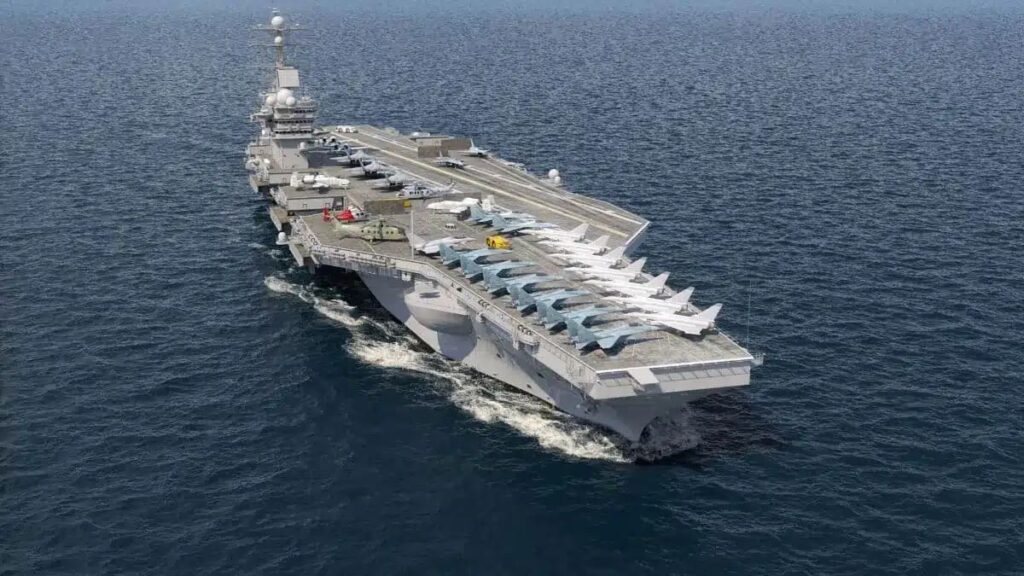
At first glance, it appears to be a blueprint torn from the pages of a Cold War spy novel. In reality, it’s France’s most significant naval undertaking in decades. Although it was introduced quietly, discussions surrounding this future aircraft carrier are resounding in defense circles. It’s already influencing how allies and adversaries perceive Europe’s military capabilities, despite the fact that it will remain landlocked for another ten years.
A Strategic Colossus on the Horizon
Set to serve by 2038, France’s upcoming aircraft carrier—dubbed the new generation carrier—signals a pivotal moment for the French Navy. It’s engineered to tackle contemporary maritime challenges while facilitating France’s sustained presence in the global maritime arena.
Once active, it will be the largest warship ever constructed in Europe and one of the most formidable worldwide. For defense analysts, particularly those at NATO, this is significant. While size alone isn’t the defining factor in naval power, it undoubtedly bolsters perceptions of strategic deterrence and ambitious intent.
A High-Stakes Collaborative Endeavor
This floating powerhouse is the result of a meticulously arranged industrial consortium. Construction responsibilities are shared between Naval Group and Chantiers de l’Atlantique, with assembly taking place in Saint Nazaire, a traditional stronghold of French shipbuilding. The nuclear components will be managed by TechnicAtome, a crucial player in France’s defense energy sector.
A formal contract is anticipated by the end of 2025, leaving little margin for delay. Defense economists emphasize that large-scale projects like this are as much about fostering national industry as they are about establishing military might. Thousands of skilled jobs hinge on adhering to the set timeline, adding economic significance to the project’s military aspirations.
A Vessel That Redefines Dimensions
The statistics tell part of the tale. The carrier will span approximately 310 meters in length and boast an 85-meter-wide flight deck. When fully loaded, it will displace around 78,000 tonnes, securing its place among the titans of contemporary naval fleets.
Onboard, approximately 1,100 personnel will perform various roles, from flight crews to command staff and technical experts. With dual nuclear reactors generating a combined output of 440 megawatts, the vessel will achieve speeds nearing 50 kilometers per hour. This propulsion system also grants it remarkable endurance, a vital aspect for projecting power far beyond home waters.
Cutting-Edge Air Power and Defense
The carrier’s air wing will encompass around 40 aircraft, ranging from Rafale Marine fighter jets and their successors to E-2D Advanced Hawkeye surveillance aircraft, essential for modern airborne command. The helicopter fleet will include NH90s and H160s.
Defensive capabilities will be robust. Layered defenses including surface-to-air missile systems like Aster missiles and Mistral 3 launchers will guard against aerial threats, while close-range protection will be provided by 40mm naval guns, ensuring safety even in crowded or hostile environments.
Innovation and a Deliberate Transition
Among the most exciting innovations is the introduction of EMALS electromagnetic catapults, similar to those on new US carriers. These systems facilitate the smoother launch of heavier aircraft, expanding operational flexibility and emphasizing France’s commitment to naval modernization.
Also enhancing detection capabilities will be Thales’ Sea Fire radar, featuring fixed active panels for continuous surveillance, significantly improving reaction time and situational awareness according to defense technology experts.
The shift from the current flagship, the Charles de Gaulle, will be methodical. While the new carrier undergoes fueling and sea trials in the mid-2030s, the existing vessel will receive upgrades to ensure continuity. This overlap is crucial for military planners tasked with maintaining uninterrupted European defense readiness.
Why Competitors Are Taking Notice
Even years ahead of its launch, the project is drawing keen interest. In a time characterized by escalating geopolitical tensions, a nuclear-powered aircraft carrier of this scale could dramatically alter regional dynamics. It solidifies France’s status as a leading military power and furnishes Europe with a unique asset in global naval operations.
As one retired naval officer poignantly remarked while overlooking the harbor in Toulon, vessels like these are constructed not merely for warfare but to avert it. Whether or not this assertion holds true will unfold in the decades to come; however, it’s clear that this carrier is already making waves long before it touches the water.





