
Building a Behemoth on the Atlantic Coast
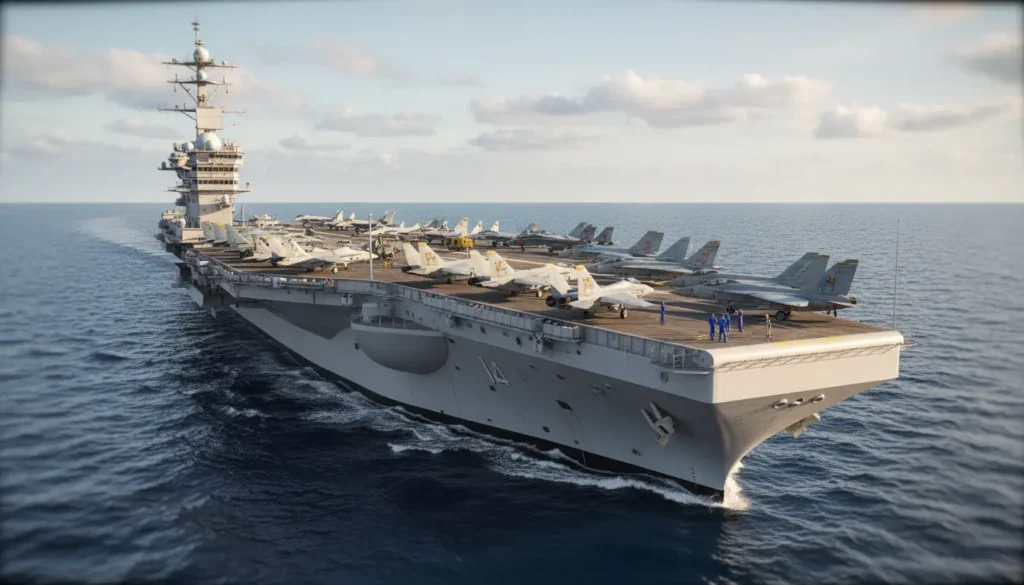
The PA-NG marks a pivotal advancement in the French Navy’s history. Set to be the largest warship in Europe and one of the most formidable globally, this carrier is slated for service entry in 2038. The development is a collaborative effort, primarily spearheaded by Naval Group, which holds a 65% stake in the project, alongside Chantiers de l’Atlantique with a 35% share. Saint-Nazaire, a shipbuilding hotspot on France’s Atlantic coast, serves as the construction site. Adding to this high-tech venture, TechnicAtome is leading the charge on the crucial nuclear boiler rooms.
Timeline Tightrope: From Concept to Construction
The order for the PA-NG is anticipated to be finalized by the end of 2025, with its delivery earmarked for 2038. This accelerated timeline underscores the strategic importance of the project for France, weighing heavily on both economic and military considerations. Delays? They’re firmly off the table, with all parties committed to adhering to the outlined schedule.
Impressive Stats: Size and Capability
The PA-NG’s dimensions are nothing short of astonishing. Measuring 1,017 feet (310 meters) in length and featuring a flight deck that stretches 279 feet (85 meters) wide, this naval giant truly lives up to its name. When fully loaded, it tips the scales at 78,000 metric tons—equivalent to more than 171 million pounds for those using American measurements. The crew comprises 1,100 personnel, organised as follows:
- 600 for the embarked air group,
- 100 officers,
- plus an additional 200 specialists.
Powering this formidable vessel are two K22 nuclear reactors, each generating 220 megawatts of power. This formidable energy source propels the ship to an impressive maximum speed of approximately 31 miles per hour (50 km/h)—quite the feat for a vessel of its size!
A State-of-the-Art Arsenal: A Magnet for Attention
This maritime stronghold is equipped for intense operations, capable of carrying around 40 aircraft. Its fleet includes Rafale Marine fighter jets (and future variants), three E-2D Advanced Hawkeye planes for early airborne warning, as well as NH90 Caïman Marine and H160 Guépard Marine helicopters—an aircraft lineup that would give any adversary pause.
In terms of defense, the PA-NG is heavily armed. It features vertical launch systems for Aster surface-to-air missiles, distributed across three eight-cell launchers on the port side. Four 40 mm Bofors cannons provide close-range defense, while Simbad-RC systems equipped with Mistral 3 missiles fortify aerial defense capabilities.
A standout feature of this carrier is its cutting-edge EMALS (Electromagnetic Aircraft Launch System) catapults. Unlike the traditional steam variant, EMALS can launch aircraft weighing up to 77,000 pounds (35 metric tons) with an extended launch stroke of 344 feet (105 meters), offering superior efficiency. The ship’s surveillance and threat detection capabilities are further enhanced by Thales’ Sea Fire active antenna radar, featuring four fixed panels that deliver advanced tracking functions.
Smooth Transition: From Charles de Gaulle to a New Era
The new carrier won’t simply replace the iconic Charles de Gaulle in an instant. Instead, the shift will happen gradually. The PA-NG is set to arrive at Toulon, the French Navy’s primary Mediterranean base, in 2035 for nuclear fueling, followed by sea trials in 2036. Upgrades to the Charles de Gaulle will be undertaken to ensure a seamless continuation of French naval operations during this transition—because every admiral understands the critical need to keep their flagship operational.





