
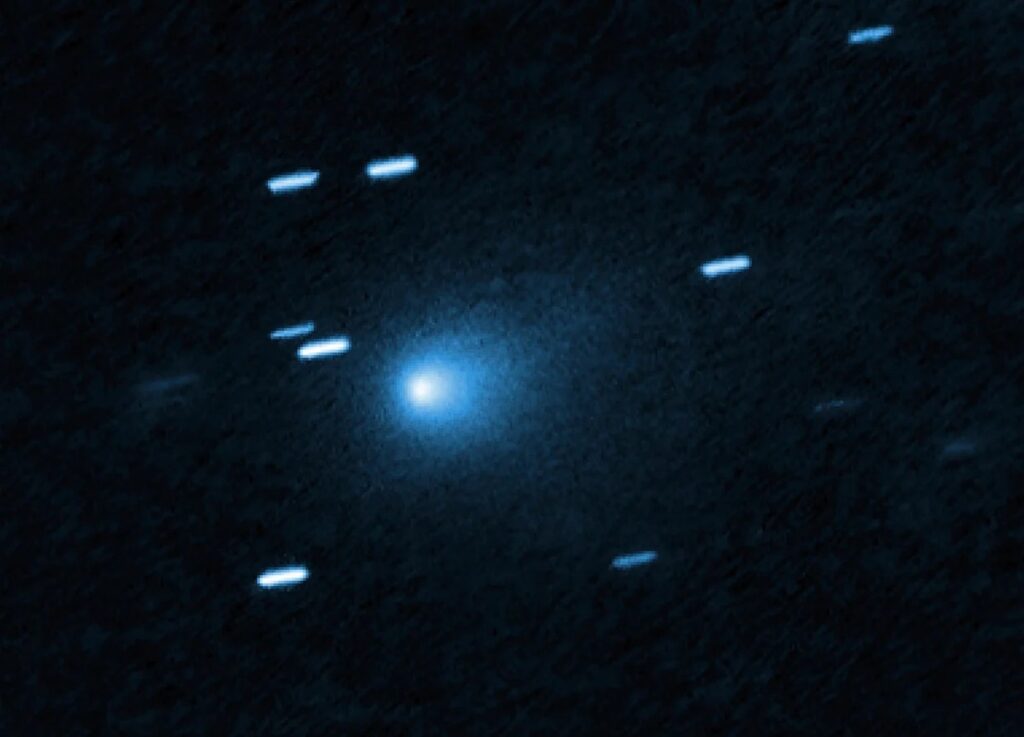
A mysterious object speeding through our Solar System has scientists in a frenzy, potentially offering insights into the very origins of the Universe. Dubbed 3I/Atlas, this interstellar intruder could be one of the oldest remnants ever observed, acting as a frozen time capsule from an era before Earth even existed.
A comet like no other
When astronomers first spotted 3I/Atlas in July, they quickly realised it was far from your average comet. With a velocity surpassing typical icy wanderers and a mass that set it apart, this object prompted researchers worldwide to delve into its origins. A team from the University of A Coruña in Spain has proposed a remarkable theory.
Their recent study, submitted to the Astrophysical Journal, suggests that this unusual comet may date back over 10 billion years—predating our own Solar System.
‘If verified, 3I/Atlas would rank as one of the most ancient objects ever detected,’ says Xabier Pérez Couto, the lead author. ‘It serves as a cosmic time capsule, holding secrets from the earliest planetary systems formed after the Big Bang.’
A 10-million-year journey of discovery
To trace its past, researchers harnessed data from the European Space Agency’s Gaia mission, which meticulously maps over one billion stars. By virtually rewinding time, they charted the comet’s trajectory over 10 million years, cross-referencing it with the orbits of over 13 million stars.
Their primary aim was clear: to locate a point in space where 3I/Atlas may have encountered another star—an interaction that could have launched it into interstellar space and eventually into our Solar System.
However, the findings didn’t match expectations. The team identified 93 close encounters, with 62 deemed significant, but none of these were substantial enough to influence the comet’s current path.
‘We didn’t find any evidence of major stellar encounters within the past 10 million years,’ Pérez Couto noted. ‘This suggests that 3I/Atlas has been on a quiet journey for a staggering length of time.’
An artefact from before our Sun
If the comet’s trajectory hasn’t been altered by recent interactions, it must have been set on its course much earlier—possibly during the tumultuous formation of the Milky Way. The researchers indicate that its composition and motion suggest it could have originated in the thin disk region housing most of our galaxy’s stars.
This implies that 3I/Atlas formed in one of the Universe’s first planetary nurseries, billions of years before our Sun ignited. Its current appearance provides a valuable opportunity to examine a material that has remained largely unaltered since the dawn of time.
‘Each observation affords us a glimpse into the early Universe,’ Pérez Couto remarked. ‘We’re analysing matter that predates the Solar System—fragments of the original building blocks that forged worlds.’
Pioneering a new era in interstellar exploration
3I/Atlas joins a select, yet expanding array of interstellar objects in our cosmic vicinity, following the likes of ʻOumuamua in 2017 and 2I/Borisov in 2019. However, its apparent age and mass render it particularly compelling.
Unlike ʻOumuamua, which mystified scientists with its unusual shape and acceleration, 3I/Atlas appears to comprise more traditional cometary material—ice, rock, and dust—offering potential insights into the characteristics of the earliest planetary systems compared to our own.
The forgotten comet
Research teams concede that pinpointing the parent star that once hosted 3I/Atlas may be an insurmountable task; our galaxy has undergone substantial changes over eons. Yet this does not diminish its significance.
For scientists, this silent traveller serves as a messenger from the Universe’s infancy—a reminder that some narratives have meandered through space for billions of years, waiting for a curious mind to uncover them.
As Pérez Couto aptly put it, with a blend of wonder and humility: ‘It’s not every day you get to study something that could be older than the Sun itself.’





