
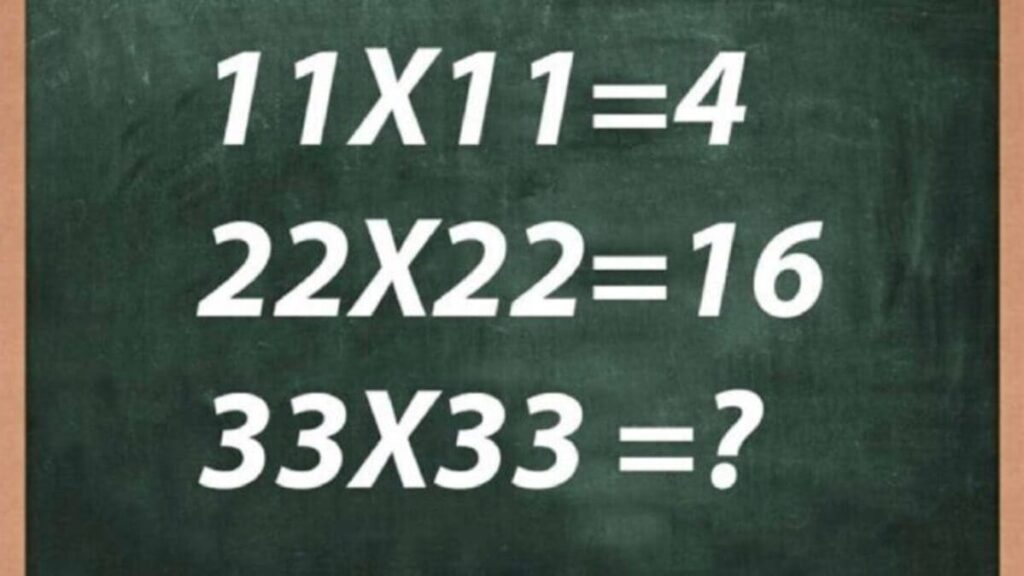
Logic puzzles have a knack for keeping us humble. What may seem like a child’s play at first glance can quickly spiral into a caffeinated frenzy, as we find ourselves scribbling on napkins, trying to crack a code. One such riddle has gone viral in recent weeks, branded as “middle school level,” yet has left even the most seasoned adults scratching their heads. Are you up for the challenge?
Decoding the Challenge
This particular puzzle appears straightforward: a sequence of equations is displayed, and your task is to discover the value of the final expression. Easy enough… right? That is, until you realise the maths doesn’t follow the typical arithmetic norms.
To solve it, you need to unearth the hidden pattern, rather than just running through basic calculations. Your interpretation of the pattern may lead you to multiple answers initially — and that’s where many get tangled up.
Two Approaches — One True Answer
When faced with pattern puzzles like this, our minds instinctively seek out a recurring structure. In this case, two distinct methods emerge:
Method 1: Adding the Previous Total
This method integrates the result from the previous line into the next equation. Here’s how it unfolds:
- 1 + 4 = 5
- 5 + (2 + 5) = 12
- 12 + (3 + 6) = 21
Continuing with this structure ultimately leads to:
- 77 + (8 + 11) = 96
Interestingly, many people’s initial instinct is to stop at an earlier stage, calculating 21 + (8 + 11), which incorrectly yields 40. It’s a classic pitfall — a stark reminder to follow the pattern to its conclusion.
Method 2: Incorporating a Multiplication Step
Some puzzle enthusiasts discern a different pattern that weaves in both addition and multiplication:
- 1 + (4 × 1) = 5
- 2 + (5 × 2) = 12
- 3 + (6 × 3) = 21
Continuing along this path:
- 7 + (10 × 7) = 77
- 8 + (11 × 8) = 96
Surprisingly, both methods converge on the same final number.
So, What’s the Real Answer?
Even with two approaches available, the puzzle is anchored in one consistent rule. Whether you view the sequence as cumulative addition or discern a hidden multiplication pattern, the final line always leads to the same solution:
The correct answer is: 96
The convergence of these two logical paths likely explains why this riddle captivates so many. It’s not merely about arithmetic; it’s about uncovering the underlying logic that governs these equations.
The Significance of These Puzzles
While they appear light-hearted, logic riddles play a crucial role in sharpening cognitive skills associated with pattern recognition, problem-solving, and reasoning, as highlighted by the American Psychological Association. Think of them as engaging brain workouts — minus the sweat, and with the luxury of a snack in hand.
If this puzzle had you doubling back on your calculations, don’t stress. You’re not alone — and now you’ve got an intriguing piece of trivia to challenge (or amuse) your friends with.





