
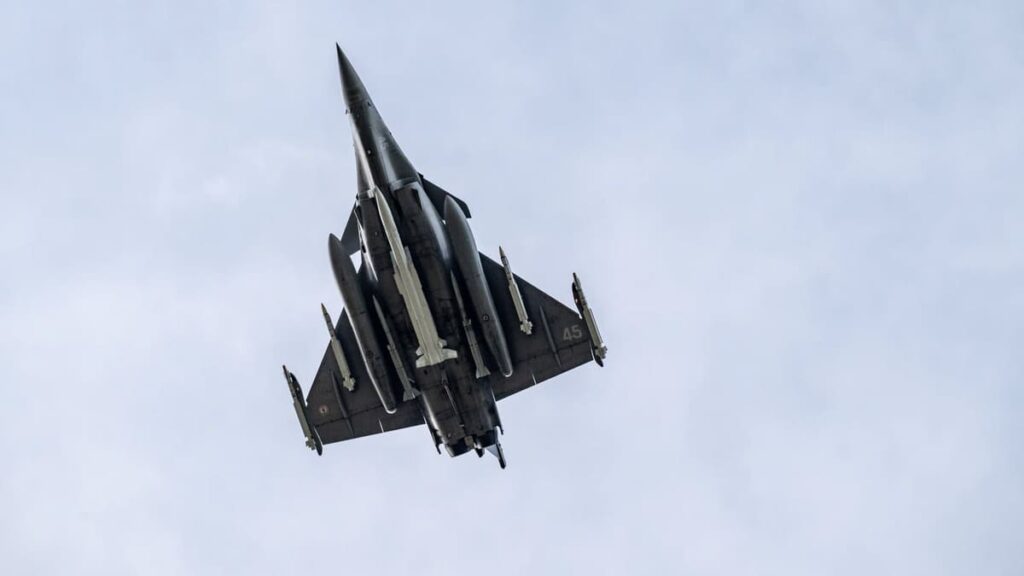
France has made a significant advancement in modernizing its nuclear arsenal, a development that is already reverberating through international relations. As global tensions escalate and major nations enhance their military capabilities, this successful test is more than just a technical achievement; it serves as a strategic statement. Let’s explore what France has tested, its implications, and how it fits into a rapidly evolving nuclear landscape.
France Finalizes Overhaul of Its Nuclear Missile System
France has officially completed a comprehensive modernization initiative for its airborne nuclear weapons. The French Navy’s Rafale fighter jets are now certified to carry the ASMPA-R, an upgraded medium-range air-to-surface missile developed by the prominent European defense firm MBDA.
This announcement comes following a successful test launch conducted by a Rafale Marine earlier this week — notably, without a nuclear warhead. According to Defence Minister Catherine Vautrin, the test marks a pivotal moment in the enhancement of France’s airborne nuclear deterrent capabilities, unifying the technological levels of both branches of its air force.
The Air and Space Force had already incorporated the ASMPA-R into its Strategic Air Forces earlier this year. Now, with the Navy fully equipped, France’s airborne nuclear arsenal is complete.
Rafale Marine’s Participation in Nuclear Deterrence
The naval air branch—known as the FANu—is structured around Rafale Marine aircraft, which can launch nuclear strikes from France’s aircraft carrier. With the recent missile certification, these carrier-based jets can now deploy France’s updated nuclear deterrent while at sea, enhancing the country’s land-based strategic capabilities.
This development equips France with a dual airborne capability, a rarity among nuclear states:
- Rafale fighters from the Air and Space Force
- Rafale Marine fighters from the Navy’s carrier group
Both branches can now utilize the newly upgraded ASMPA-R, which aligns with the enhancements made to France’s submarine-based nuclear fleet.
Establishing a Fully Modernized Nuclear Triad
The timing of this announcement aligns with France’s broader modernization strategy. Recently, the country confirmed the operational deployment of its M51.3 intercontinental ballistic missile on its fleet of ballistic missile submarines, which serve as the backbone of France’s maritime deterrent.
Following these upgrades, France can now effectively maintain modern nuclear systems across the following domains:
- Airborne forces (ASMPA-R)
- Naval ballistic submarines (M51.3)
However, France is not stopping here. Development is already underway for two next-generation systems:
- the ASN4G, a fourth-generation air-to-surface nuclear missile anticipated by around 2035;
- the M51.4, the next iteration of France’s submarine-launched ballistic missile.
In short, France is committed to maintaining the credibility of its nuclear deterrent well into the future.
“A Troubling Atmosphere” in the Global Nuclear Arena
This push for modernization is not taking place in isolation. The French Defence Ministry has recognized a significant degradation in the global nuclear landscape, with various events raising alarms in Western capitals:
- Russia is testing new strategic weapons and discussing nuclear deployment scenarios openly.
- The United States has hinted at the potential for resuming nuclear tests under the Trump administration.
- China continues to rapidly expand and diversify its nuclear arsenal.
The Stockholm International Peace Research Institute (SIPRI) reports that all nuclear-armed states are currently investing in new warheads or delivery systems — a trend reminiscent of the Cold War.
Against this backdrop, France’s message is unequivocal: its nuclear deterrent must be technologically credible, survivable, and up-to-date.
Beyond the Test: The Significance of This Moment
While the ASMPA-R test may seem like a technical affair, it carries profound strategic significance. Nuclear deterrence — despite the controversy surrounding it — rests on one fundamental principle: credibility. If a system is perceived as outdated or unreliable, its capacity to deter aggression diminishes.
By certifying the ASMPA-R on both Air Force and Navy Rafale jets, France:
- enhances its strategic autonomy,
- reinforces its position as a key nuclear power in Europe,
- and signals its preparedness in an increasingly unpredictable world.
As global powers test or indicate intentions to develop new nuclear capabilities, France’s modernization initiative highlights a simple truth: deterrence is evolving — and France is determined to keep pace.





