You thought tomato puree and tomato sauce were interchangeable? Between a watery bolognese and a sugary pizza, the nuance that changes your dishes lies elsewhere.
You bought tomato puree instead of tomato sauce, or vice versa, and your bolognese came out too acidic or too liquid? Rest assured, this confusion is very common, even among comfortable cooks.
The two products look similar and start from the same ingredient, but they do not behave the same way at all during home cooking.
Behind the simple label lie two products that are quite different in texture, seasoning, and concentration. Understanding the difference between tomato puree and tomato sauce allows you to choose the right jar, avoid failures, and know how to fix a recipe when you do not have exactly what is written.
Tomato puree: the thick and neutral base
Puree is the simplest version: tomatoes and almost nothing else. “Canned tomato puree is made from fresh tomatoes,” explains Caroline Wright, brand manager at take root organics, as quoted by EatingWell.
She adds that “they go through a heating and filtering process until the desired puree consistency is reached.” A short cooking time, followed by blending and straining, gives a smooth, thick texture without a heavily cooked taste.
The result is a puree that is rather acidic, low in sugar, and bright red in color. It easily thickens a marinade, a pizza sauce, or a stew.
Since it is minimally seasoned or unseasoned, you maintain control over the salt, herbs, garlic, and oil. This is practical if you are cooking for children or limiting sugar.
Tomato sauce: a pre-cooked and seasoned puree
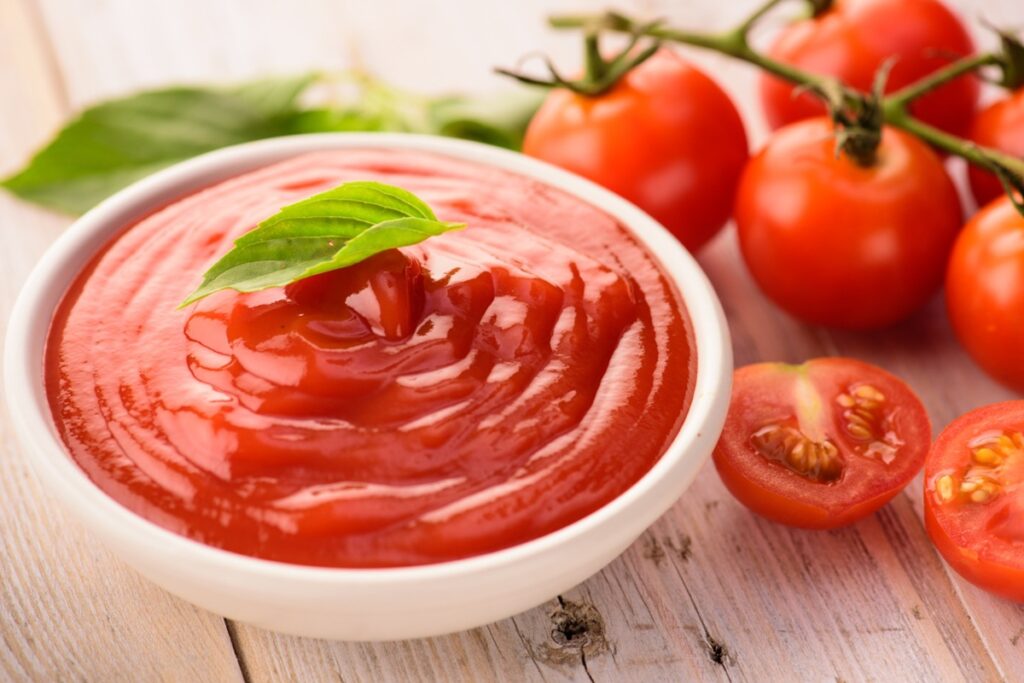
Store-bought tomato sauce almost always starts from puree, but water, salt, sugar, garlic, onion, herbs, and often oil are added. According to Caroline Wright, “canned tomato sauce generally has a thinner consistency and a glossy appearance compared to canned tomato puree. To transform tomato puree into tomato sauce, ingredients like sea salt and spices are added to the tomato puree, and then the product is milled to achieve a finer texture.”
The whole mixture simmers longer, which rounds out the flavor.
This cooking time and the added sugar increase the sweetness and soften the acidity. Many sauces exceed 5 g of sugar per 100 g. This is why Caroline Wright advises to “check this to avoid tomatoes with too much added sugar or salt.”
It is ideal for express pasta or lasagna, but less so for homemade pizza where a denser, less sweet base is usually preferred.
Can they be swapped without ruining the dish?
Puree remains thicker: you can transform it into a sauce by diluting it gradually and cooking it. A simple method is to sauté a little garlic and onion in oil, add the puree, then add water or broth until the desired texture is reached, before letting it simmer long enough for the flavors to develop.
- To go from puree to sauce: dilute, salt, sweeten slightly if needed, flavor with herbs, and let cook so the taste transforms.
- To go from sauce to puree: reduce over medium heat without a lid until a coating texture is achieved, keeping in mind to correct the salt and sugar as they concentrate.
In practice, keep in mind that tomato sauce is a puree that has already been worked on: convenient when you are short on time, but less flexible if you want to precisely control the seasoning.
For a pizza, a long-simmered dish, or a homemade base to your liking, tomato puree, more concentrated and neutral, remains your best ally. For busy evenings where you just need to coat some pasta, the ready-made sauce is very helpful, provided you taste, adjust, and know what is actually in the jar.