
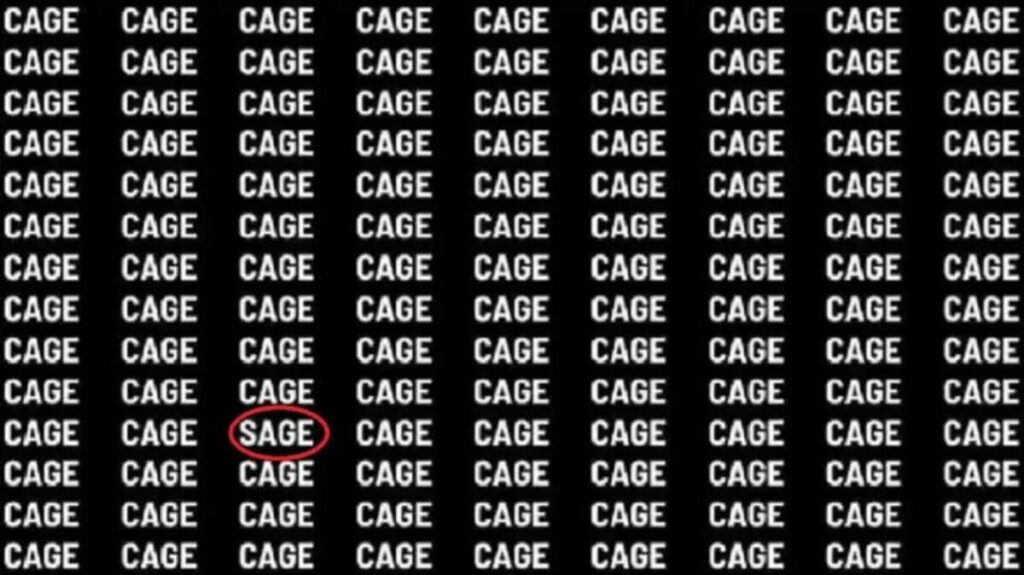
Ever felt curious about the true acuity of your eyes—and your mind? Here’s a visual challenge that’s been circulating online, designed to put your observation skills and concentration to the test. The premise is straightforward: spot the word ‘sage’ hidden among a sea of ‘cage’ within 15 seconds, and you’re said to possess perceptive skills typically associated with an IQ above 98. Think you can do it?
A Puzzle Phenomenon That Tests More Than Patience
Visual puzzles like this have seen a remarkable rise in popularity in recent years, popping up in everything from social media feeds to family WhatsApp chats. They promise not only entertainment but also a serious cognitive workout. Psychologists at the University of Cambridge note that regular engagement with such games can enhance your focus, visual memory, and reasoning speed. In essence, these puzzles are not merely distractions; they’re effective tools to sharpen your mind.
If you’re feeling that mid-afternoon slump, consider swapping your phone scroll for a quick brain teaser—it might serve you better than another cup of coffee.
The Challenge: Spotting ‘sage’ Among 88 ‘cage’
At a glance, the puzzle may appear deceptively simple. A grid filled with the word ‘cage’ repeated 88 times—yet nestled within that jumble is a lone ‘sage.’ This test relies heavily on your ability to observe, demanding both concentration and speed.
The challenge is rooted in how our brains process patterns. We’re naturally adept at recognizing familiar shapes and sequences, so when a slight deviation occurs—like ‘s’ in ‘sage’ instead of ‘C’—our brains can take a moment to catch up. Puzzles like this provide a unique satisfaction; when you finally spot the word, it feels like a small victory for your neurons.
If you manage to find it in under 15 seconds, kudos to you! Research indicates that individuals who excel in rapid visual recognition tasks often possess above-average IQ scores, especially in problem-solving and pattern detection.
Beyond Entertainment: The Value of Puzzles
While hunting for hidden words may seem trivial, there’s genuine science supporting its benefits. The British Psychological Society explains that visual reasoning exercises like this can enhance everyday skills—ranging from spotting details in written content to improving spatial awareness while driving. These activities train your eyes and brain to work in harmony.
Additionally, there’s a stress-relief aspect to it. A few minutes of focused engagement can pull you into a ‘flow’ state—a blissful zone of total absorption, akin to what artists, athletes, and even chess players experience when fully immersed in their craft.
Take It Further: Make It a Family Challenge
And this game isn’t just for adults! Challenging children with these visual enigmas can enhance their cognitive flexibility—that is, their ability to switch between different thought processes. Educators often incorporate similar exercises to bolster reading fluency and attention spans in younger students.
Why not turn it into a family competition? Set a timer for 15 seconds, gather everyone around, and see who can spot ‘sage’ the quickest. You might be surprised by the outcome—children, with their keen eyesight and fresh perspectives, often outstrip adults in these challenges.
So, How Wise Are You?
If you quickly uncovered the elusive word, give yourself a silent round of applause. You’ve not only demonstrated sharp eyesight but also impressive mental agility. And even if it took you longer than 15 seconds, that’s perfectly fine—the true wisdom lies in enjoying the journey and keeping your mind active.
As experts like Dr. Catherine Loveday argue, mental flexibility improves with practice. The more you challenge yourself with these little tests, the sharper your perception will become.
Who knew that a simple assortment of letters could reveal so much about your cognitive prowess?





