
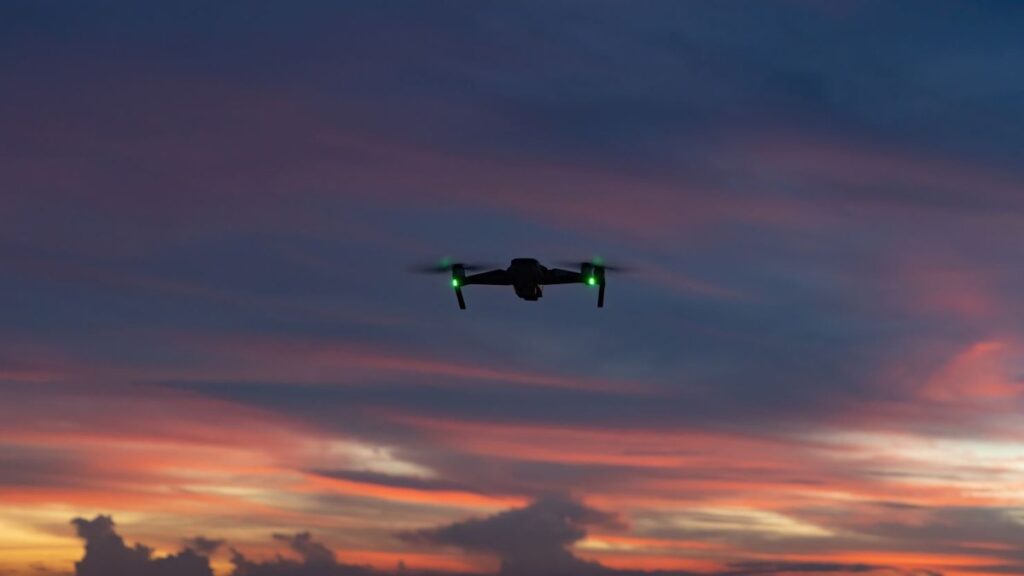
A small buzzing object in the sky has emerged as a significant security concern across Europe. In recent months, unidentified drone sightings have led to disruptions at airports, military installations, and even national celebrations. Now, Munich—one of Europe’s key transportation hubs—has been forced to ground flights for the second night running. As officials scramble for explanations, an increasing number of EU nations are pointing to a common adversary.
Flight Shutdown at Munich Airport Due to Drone Sightings
For the second consecutive night, Munich Airport halted all flight operations following new reports of unidentified drones hovering near the runways. The disruption commenced on Friday, October 3, at 9:30 p.m., affecting 6,500 passengers and leading to the cancellation, diversion, or rescheduling of 69 flights.
According to police reports to AFP, two separate patrols spotted drones near the north and south runways just prior to 11 p.m., despite earlier sightings not yet being officially validated.
In an effort to assist stranded passengers, the airport provided food and established makeshift sleeping areas. While there were hopes to resume operations by 5 a.m. Saturday, officials cautioned that additional disruptions could arise.
This incident marks the second significant airport closure within a 24-hour period. The preceding night saw more than 30 flights canceled, leaving 3,000 travelers stranded overnight.
Germany Labels Drone Incidents a “National Security Threat”
The timing of these shutdowns coincided with Germany’s national reunification holiday, amplifying political anxiety. Interior Minister Alexander Dobrindt described the incidents as a “threat” and asserted to Bild that authorities should be empowered to immediately neutralize drones instead of waiting for confirmations.
Under existing German legislation, only police—and not the military—are authorized to address drones in civilian airspace. The government under Chancellor Friedrich Merz is now considering revising aviation security regulations, with discussions scheduled for next Wednesday.
Berlin’s concerns have shifted from hypothetical to urgent, as multiple drones were confirmed flying near Erding, where the German army operates an airfield, and directly above Munich’s main civilian airport.
A Broader European Trend: Other Affected Airports
Munich isn’t the only airport grappling with this issue. In recent weeks:
- Copenhagen temporarily suspended operations due to drone activity.
- Oslo also grounded flights because of similar incidents.
- Poland has reported repeated incursions into its airspace.
- Romania and Estonia have raised alarms about suspicious flights over military installations.
Governments, especially those in Poland, Romania, and Estonia, increasingly suspect Russia of employing low-cost drones to test European defenses. Moscow has denied these allegations.
Past accusations include Poland claiming that 19 drones flew across its airspace. Similar claims have emerged from Danish authorities following drone overflights above Copenhagen Airport and various military sites in rapid succession.
Uncertainty Surrounds Drone Origins
Despite rising suspicions, no conclusive evidence has identified the operators of these drones. Authorities in Denmark, Germany, and Poland suggest the activity appears to be orchestrated rather than the work of amateur operators.
These incidents reveal a troubling reality: a gap in NATO’s defensive capabilities. Small, inexpensive drones present a challenge to detect and intercept without compromising civilian air traffic—potentially a vulnerability that adversaries are keen to exploit.
EU Explores “Anti-Drone Wall” Initiative
This past Thursday, all 27 EU member states convened in Copenhagen to tackle the escalating drone threat. Among the proposals being considered is the establishment of an EU-wide “anti-drone wall”, which could include radar systems, jamming technology, rapid-response teams, and collective intelligence networks to intercept hostile or unidentified drones in real time.
As the disruptions persist, it’s evident that Europe is entering a new phase where airport chaos may arise not from adverse weather, strikes, or technical failures, but from silent drones no larger than a dinner plate.





