
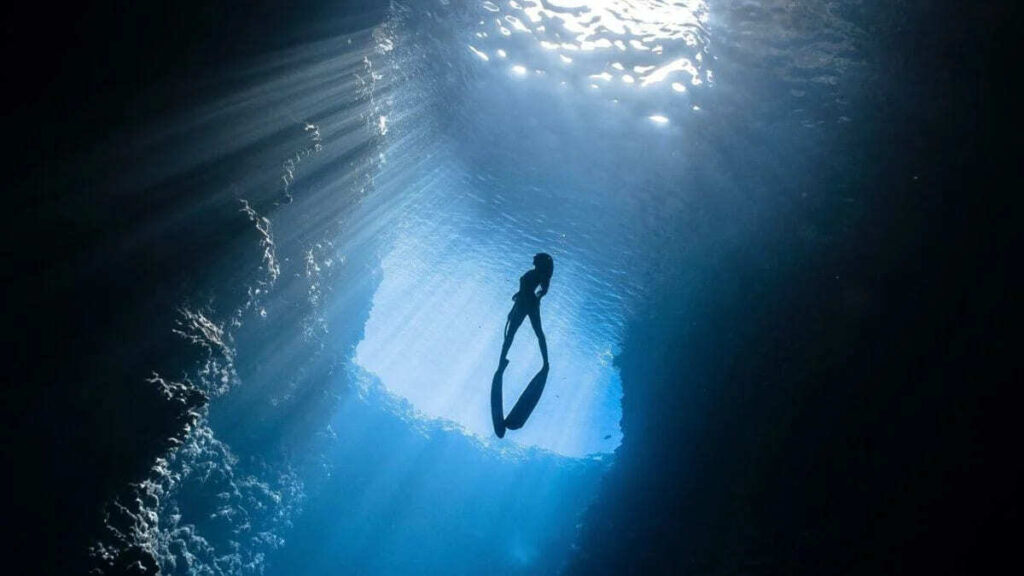
Picture this: the deep sea has long been a source of intrigue, but a groundbreaking revelation suggests there might be an even larger ocean lurking beneath our feet. Scientists digging 700 kilometers into the Earth’s mantle have uncovered evidence of a vast underground ocean. To put it in perspective, this hidden reservoir could contain three times the amount of water found in all surface oceans combined.
An Enormous Ocean Beneath Our Feet
The origins of Earth’s water have puzzled scientists for years. Was it delivered to us by icy comets, or did it originate from the depths of the Earth itself? Recent discoveries suggest a shift towards the latter explanation.
Research on a mineral called ringwoodite, a blue rock located within the mantle, reveals that it can trap significant amounts of water within its structure. This secret reservoir, buried nearly 700 kilometers below the surface, is being referred to as a “mantle ocean,” and its existence could change everything we know about the history of Earth’s water.
Some experts believe this breakthrough may completely alter our understanding of how Earth’s oceans formed. Instead of a cosmic delivery, it appears much of Earth’s water could have gradually seeped outward from the interior. This revelation challenges conventional wisdom and redefines the narrative of our planet’s hydrological history.
Detecting an Invisible Ocean
Identifying an ocean that is neither visible nor tangible presents a unique challenge. To uncover this hidden marvel, geophysicists employed over 2,000 seismographs across the United States, analyzing seismic waves generated by more than 500 earthquakes.
When seismic waves pass through wet rock, they exhibit a slowdown in speed. This slight delay, meticulously measured, allowed scientists to locate significant reservoirs of water trapped deep beneath the Earth’s crust. As Northwestern University’s Steven Jacobsen pointed out, “This is the most convincing evidence we have that Earth’s water originated from within.” He added that this colossal reservoir could also elucidate why ocean levels have remained relatively stable over millions of years. Without this hidden buffer, the Earth may have looked entirely different, with extensive flooding and only the tallest mountains visible above the waterline.
Rethinking the Water Cycle
This discovery has far-reaching implications, not only for our understanding of the past but also for how we perceive the future. If vast quantities of water are indeed trapped deep within the mantle, it implies that our water cycle is far more intricate than merely evaporation and rainfall.
Current theories now suggest that water gradually circulates between the surface and the interior over geological time, “sweating” through the mantle in tiny channels between mineral grains. This ongoing exchange may have played a crucial role in maintaining stable ocean levels, allowing life to thrive on our planet.
The next steps in research will focus on gathering seismic data from across the globe to ascertain whether this mantle-bound water is a worldwide phenomenon. If so, scientists might be on the brink of revolutionizing our understanding of one of the most fundamental aspects of Earth’s operations.
This discovery highlights that even in an era dominated by satellite imagery and advanced computer simulations, Earth still harbors incredible secrets—some deep enough to reshape our grasp of its history and the ongoing processes beneath our feet.





