
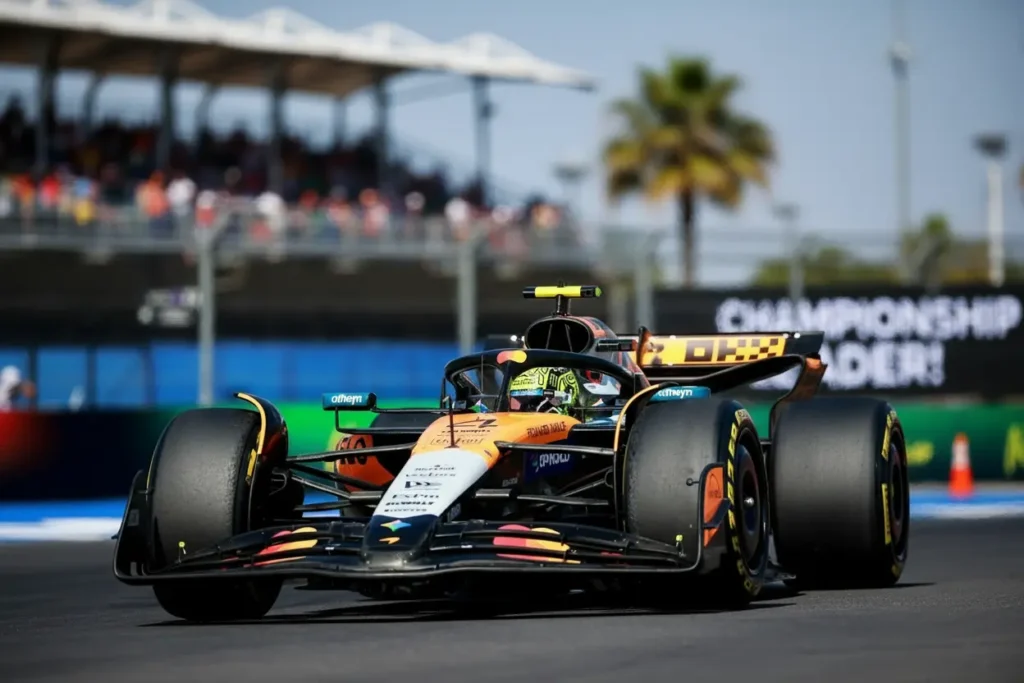
The tumultuous journey to peak performance
This season hasn’t been straightforward for Norris, despite having a car rich with potential. Right from the outset, he found it difficult to fully exploit the McLaren’s speed—it’s fast, yes, but mastering it requires more than innate talent. The nadir of his struggles occurred at the Singapore Grand Prix, where Norris walked away dissatisfied with the car’s handling. Determined to turn things around, he returned to foundational principles with the team, seeking a new strategy.
“It’s hard to pinpoint exactly, but I felt much more comfortable in the car today,” Norris shared with Sky Sports F1 after his win in Mexico. “Everything ties back to my comfort within the car. Last year, I felt great and could perform better. This year, I struggled to adapt. It’s incredibly fast, but clearly still a challenge to drive.”
What shifted in Mexico? For Norris, it was the feeling of finally being at home behind the wheel—a sensation that had eluded him in previous races, even in Singapore.
Regaining focus after obstacles
As Piastri collected accolades in the early part of the season, Norris was acutely aware that he couldn’t place the blame solely on McLaren. This prompted some introspection—and a fair share of second-guessing:
“There were moments at the beginning of the year where I felt that way, because I never want to criticize my car. The car was winning, and Oscar was winning, so using the excuse of an inadequate car was the last thing I wanted to do.”
However, the breakthrough didn’t come without its hurdles. Norris candidly explains the journey:
“I wasn’t settling in, and finding a way to make it work was tough. Now, I’ve figured out a better approach to driving it. It’s as straightforward as that.”
Following the Singapore race, he and the team engaged in a lengthy, forthright discussion—ninety minutes filled with hard truths and constructive criticism. Norris was upfront about his preferences, right down to the specifics of the car he required; in his own words, ‘we simply can’t win if it doesn’t provide me what I need.’ In Mexico, he finally received a taste of what he had been longing for, and it proved pivotal.
Track conditions: a boon for Norris, a bane for Piastri
The unique circumstances of the Mexico City track undeniably influenced the outcome. With the asphalt notoriously low on grip, Piastri found himself adjusting to a driving style not naturally suited to him, while Norris thrived under such conditions.
According to McLaren team principal Andrea Stella:
“He was able to leverage the car’s strengths and performance. These special low-grip conditions played right into his hands. They provide a natural way for him to achieve lap time—nearly the polar opposite of Oscar’s driving style.”
In the paddock: an unwavering passion for motorsport
Our coverage spans the world of motorsport, from Formula 1 to MotoGP, driven by a genuine love for the sport—bringing you inside stories straight from the paddock, complete with insights from those who are entrenched in racing. To keep our operations up and running, our website features advertising. However, if you prefer an ad-free motorsport experience trackside, simply enable your ad blocker and enjoy the thrill without interruptions.
This rewrite adopts an Australian journalistic style, incorporating clarity, narrative flow, and a focus on the emotional and technical aspects characteristic of motorsport reporting.





