
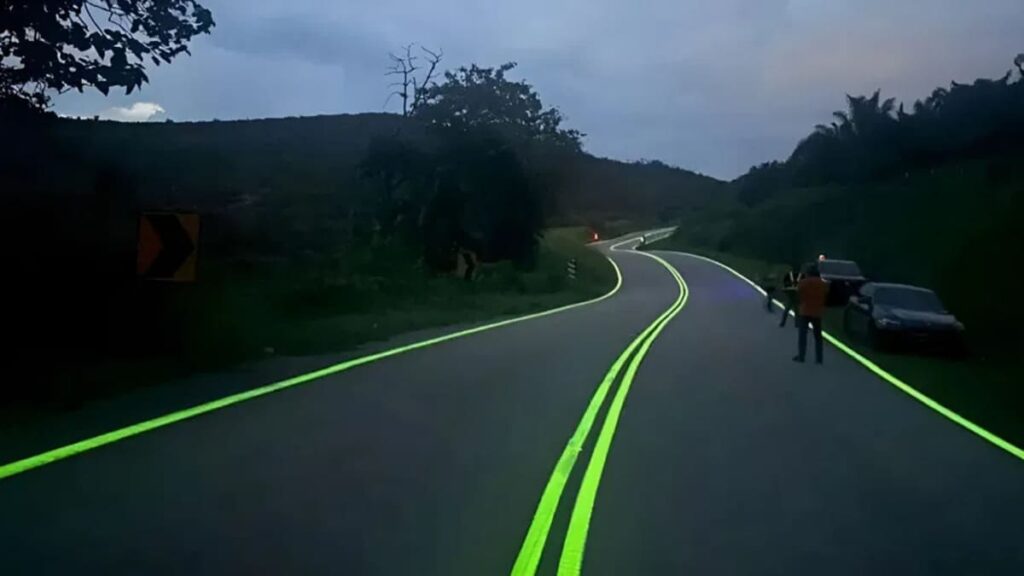
Malaysia’s latest experiment in enhancing nighttime driving safety has turned heads, featuring glowing road paint that illuminates after dark. Initially, it seemed like an ingenious solution, especially in rural areas lacking adequate street lighting. However, as the pilot program progresses, the nation is learning that even the most brilliant ideas can cast unexpected shadows.
An ambitious concept that initially dazzled
When a nation seeks to enhance road safety, conventional tools like streetlights, reflective markers, or advanced sensors typically come to mind. Yet Malaysia has opted for something more eye-catching: photoluminescent road markings. These luminous lines, installed along a 245-metre stretch in Hulu Langat, quickly garnered approval from drivers who appreciated improved visibility on previously dark rural routes.
The idea behind the glowing paint is straightforward but enticing. It absorbs sunlight during the day and emits a soft glow at night, providing clearer guidance in adverse weather conditions and on unlit roads. Officials heralded it as a potential breakthrough, and drivers seemed to agree.
The cost of innovation
However, like many innovative concepts, this one faced the harsh realities of budget constraints. The glowing paint came at an astonishing price of 749 Malaysian ringgits per square metre, while conventional road markings cost around 40 ringgits—approximately twenty times cheaper. Such a stark price difference is enough to make even the most ardent supporter of innovation rethink the feasibility of the project.
A public works engineer I encountered once summed up the situation perfectly: ‘You look at the numbers twice, hoping they’ll change the second time.’ Unfortunately, in Malaysia’s case, they didn’t.
Navigating the balance between safety and sustainability
This initiative raises a significant question that many governments grapple with: how far should they go in pursuing innovation when cost threatens to overshadow the intended benefits? The World Road Association emphasizes that sustainable safety systems rely not only on creative solutions but also on their financial feasibility. Malaysia found itself in a precarious position, torn between a promising concept and a price tag that proved too steep for widespread implementation.
Despite receiving positive feedback from the public and the allure of a road system reminiscent of a science fiction landscape, the government retracted its commitment to the project late last year. What once appeared to be a forward-thinking solution became merely a footnote in discussions about balancing innovation with practicality.
The lesson from a bright idea
Photoluminescent paint serves as a reminder of a familiar truth: sometimes, the most appealing innovations come with hidden costs that can outweigh their initial allure. A road safety educator encapsulated it well in a recent discussion: ‘The safest roads aren’t the cleverest ones. They’re the ones we can afford to maintain every day.’ This perspective resonates with transport safety advocates, who continuously underscore that visibility, reliability, and sustainable upkeep are far more critical than novelty.
What lies ahead for Malaysia’s nighttime roadways?
Looking ahead, Malaysia will likely revert to tried-and-true methods such as traditional lighting, reflective studs, and standard paint—solutions that may lack a futuristic shine but provide reliable results without straining public finances.
The country’s brief dalliance with luminous paint will be remembered as an intriguing diversion rather than a new norm. Until costs decrease, its roads will remain less illuminated, reinforcing a vivid lesson: innovation, visibility, practicality, and responsible spending must all align to ensure a safe journey toward progress.





