
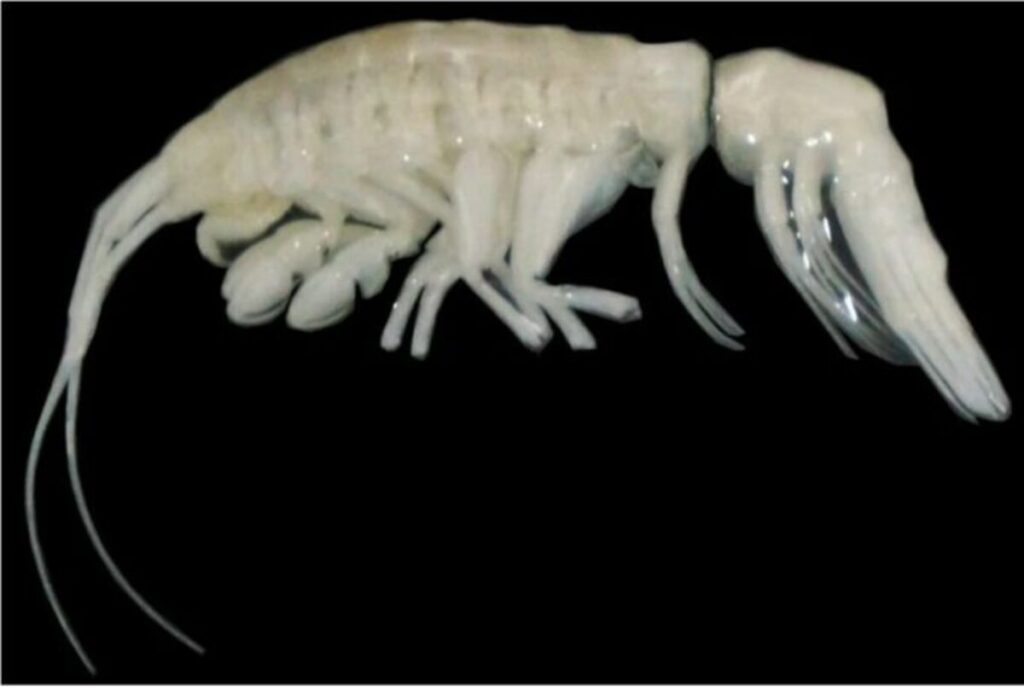
Deep within the shadowy depths of our oceans, where sunlight dares not venture, researchers have stumbled upon a remarkable new predator. This fascinating find, made in the hadal zones, offers an intriguing perspective on the enigmatic and, at times, fearsome beings that dwell in our planet’s extreme underwater trenches.
A New Predator Emerges from the Abyss
Meet the Dulcibella camanchaca, a striking new species of amphipod, or shrimp, discovered at an astonishing depth of nearly 8 kilometers (around 5 miles) beneath the ocean’s surface, nestled in the Atacama Trench off the coasts of Chile and Peru. Though it contains a somewhat intimidating appearance, this minuscule creature only measures approximately 4 centimeters (about 1.5 inches) in length. Armed with specialized adaptations, it proves to be a formidable predator in its dark domain.
This unique discovery occurred during the IDOOS 2023 expedition, a deep-ocean observation mission aimed at unraveling the enigmas of the ocean’s abyssal and hadal zones. The species, aptly named with reference to the Andean term for darkness, underscores its existence in environments where sunlight is a mere myth. In these extreme, pitch-black depths, Dulcibella camanchaca not only survives but thrives.
A Tiny Terror with Remarkable Abilities
At first glance, the Dulcibella camanchaca may look unremarkable, but it is, in fact, a highly specialized predator. Perfectly adapted to life in total darkness, this tiny beast preys chiefly on other amphipods, employing its prehensile appendages to skillfully seize and immobilize its meals. It has cemented its role as a fearsome hunter of the abyss.
Johanna Weston, co-director of the study from the Woods Hole Oceanographic Institution (WHOI), highlights that the species is not just an agile swimmer; it is also an expedient and proficient predator. The hunting techniques of this organism are finely-tuned, providing a fascinating glimpse into how life adapts and flourishes under extreme conditions.
An Exciting New Addition to Science
This discovery is significant not just because Dulcibella camanchaca is a new species, but also because it represents a completely new genus. In biological classification, the genus serves as a category that unites species with common characteristics, while the species is the most specific classification, identifying organisms that can interbreed and share physical traits.
The researchers validated their findings through extensive morphological and genetic analyses, published in the journal Systematics and Biodiversity. Uncovering a new genus indicates there are entire classifications that have previously evaded scientific discovery.
Carolina González, co-director of the study from the Instituto Milenio de Oceanografía (IMO) in Chile, emphasized the crucial nature of this discovery. It highlights the urgent need for continued exploration of the Atacama Trench and other deep-sea regions, particularly within Chile’s territorial waters.
The Urgent Call for Ocean Exploration and Conservation
The ocean’s hadal zones, ranging from 6 to 11 kilometers deep, are not the barren wastelands some might presume. They are vibrant ecosystems, teeming with unique species that scientists are just starting to grasp. Given the looming threats posed by human activity, such as pollution and climate change, safeguarding these regions while continuing to explore them is of the utmost importance.
The discovery of Dulcibella camanchaca and other similar species marks the dawn of a potentially transformative era in marine exploration. As we delve deeper into these underexplored waters, we gain insights into life in its most extreme forms and learn how various organisms adapt to thrive in some of the harshest environments on Earth.
In summary, the Dulcibella camanchaca serves as a potent reminder of the vast unknowns still contained within our oceans. It symbolizes the resilience of life and the countless mysteries that lie beneath the surface, eagerly awaiting exploration and understanding.





