In an audacious initiative that could redefine our travel experiences, China is breathing new life into hyperloop technology—a concept once championed by Elon Musk—with plans to significantly accelerate train speeds. While the hyperloop concept may have waned in popularity in the U.S., China is gearing up to deploy maglev technology within vacuum tubes, setting sights on train speeds that could reach astonishing levels of 1000 km/h. Let’s dive into their ambitious vision.
Aiming to Triple Train Speeds
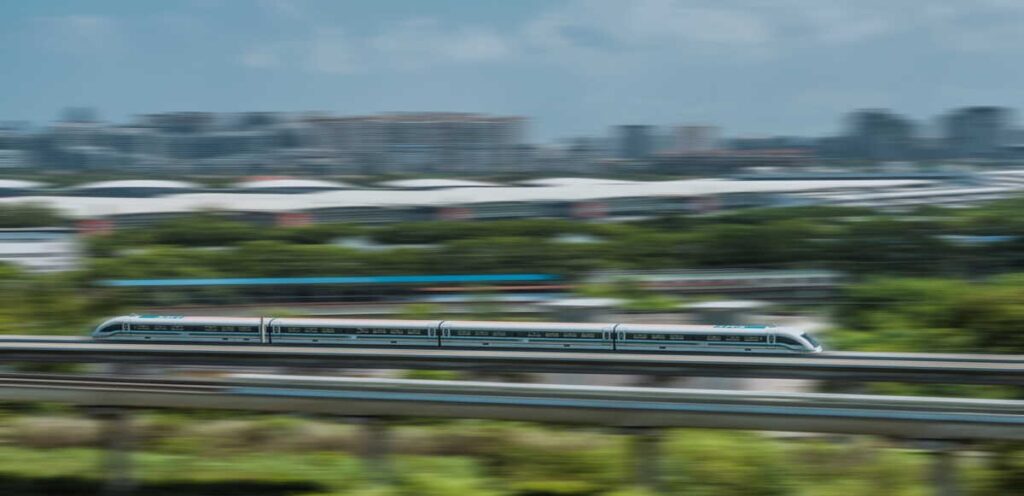
Picture a train racing along at nearly three times the speed of the current fastest maglev trains. This is the target that China has set for itself. Presently, the nation’s high-speed trains can achieve a top speed of 350 km/h, which is impressive in its own right. Yet, China is eager to push the boundaries further with a new generation of trains that harness magnetic levitation to achieve even faster velocities. This involves the innovative use of vacuum tunnel technology, originally inspired by the hyperloop concept.
The Mechanics: Merging Maglev with Hyperloop
Maglev technology, employing magnetic fields to elevate trains above the tracks and reduce friction, isn’t a new concept. Japan’s renowned Shinkansen already operates on similar principles, hitting speeds of up to 500 km/h. However, for China, even that speed isn’t sufficient. To significantly enhance velocities, engineers are focused on integrating maglev technology with the low-pressure environment of an hyperloop.
By encasing trains within vacuum tubes, they aim to eliminate air friction, a major barrier to high-speed travel. With diminished air resistance, China aspires to reach speeds that approach the speed of sound, targeting a staggering 1000 km/h.
Tackling Connectivity Issues
One major hurdle of such rapid transit is ensuring internet connectivity. At speeds nearing the sound barrier, maintaining a stable mobile connection is challenging due to the difficulty in keeping a consistent signal with cell towers. However, researchers from Southeast University in China have proposed an innovative solution.
They suggest installing two parallel cables along the hyperloop tunnel walls to emit electromagnetic signals. This approach seeks to provide continuous, reliable connectivity even at remarkable speeds. The researchers anticipate that this system could deliver mobile internet akin to 5G, enabling passengers to enjoy seamless connectivity while hurtling through the tubes.
The Prospects for Hyperloop in China
While the project remains in its infancy and challenges regarding safety, regulations, and infrastructure persist, China is steadfast in its plans. The first hyperloop line is projected to be up and running by 2035, and if this ambitious venture succeeds, it could herald a new era of ultra-fast travel, fundamentally altering our transportation landscape.
For the time being, the world watches closely as China forges ahead with its cutting-edge technology that could bring these futuristic trains to life. The coming years will be pivotal in determining whether our daily commutes might eventually reflect the high-speed journeys depicted in science fiction.