
From Paris to Beijing: The Unexpected Turns of Bangladesh’s Fighter Jet Journey
Not long ago, Bangladesh’s air force modernization program was a hot topic in aviation circles across Dhaka and beyond. Leading the charge were Dassault Aviation’s Rafale and the Eurofighter Typhoon, both serious contenders for the Bangladeshi fleet, which has long relied on a cadre of outdated Chengdu F-7 jets—essentially the Chinese counterparts of the Soviet MiG-21—and a handful of elderly Russian MiG-29s.
There were indications that the Rafale was the front-runner, with reports suggesting Dhaka was considering acquiring an initial four pre-owned jets from the French Air & Space Force, along with the possibility of eight more upgraded to the F4 standard. However, a shocking regime change in August 2024—prompting Bangladesh’s prime minister to flee to India—brought discussions with France to an abrupt halt.
The Eurofighter Typhoon, backed by Leonardo, soon gained traction. In May, Air Force chief Hasan Mahmood Khan toured Leonardo’s facilities in Italy to witness the Typhoon in action. By September, he was establishing stronger ties with Antonio Alessandro, Italy’s ambassador to Bangladesh, discussing enhanced military cooperation. The newly installed caretaker government, led by Muhammad Yunus—yes, that Muhammad Yunus, the Nobel Peace Prize laureate known for microcredit—approved preliminary plans to procure “multirole fighter aircraft” and air defense systems.
Welcome the J-10CE: A New Challenger Emerges
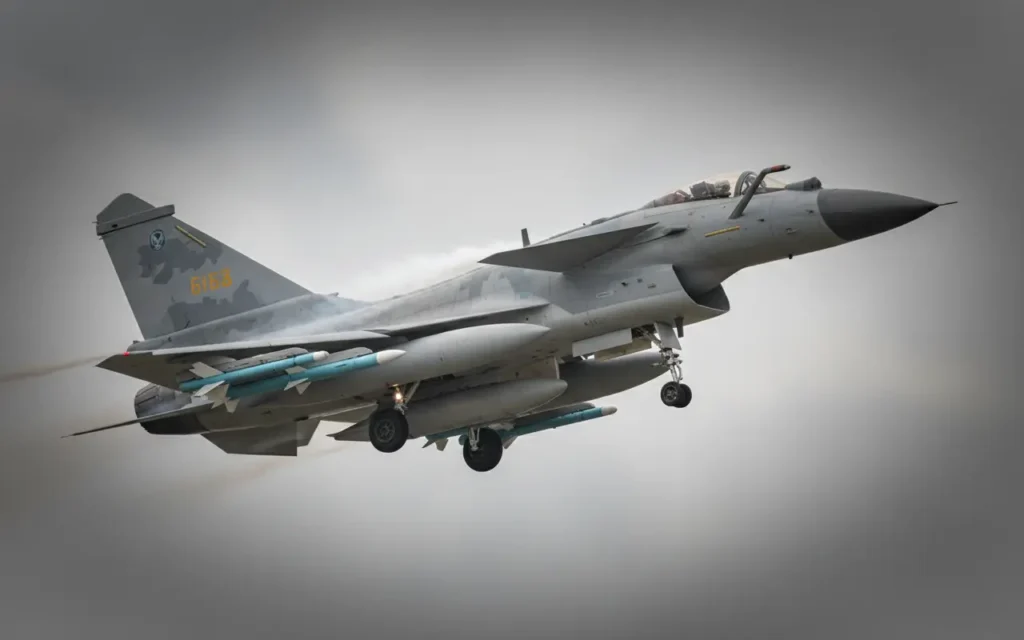
Just when it seemed the narrative had settled, a wild card emerged in the form of China’s Chengdu J-10CE, a jet already cherished by Pakistan and China. Following a high-profile meeting between Yunus and Chinese President Xi Jinping in March, the decision to pivot towards Beijing was practically locked in. Beijing escalated its information warfare against the Rafale following skirmishes between India and Pakistan, further bolstering China’s chances.
The Bangladeshi caretaker government has earmarked a considerable budget of $2.2 billion over the next decade to support the acquisition of much-needed combat aircraft, as the aging fleet of J-7s faces an urgent replacement dilemma.
Reports suggest this new government structure “will assess the draft agreement, evaluate the feasibility of purchasing the aircraft directly from the Chinese government or authorized agencies, and negotiate vital terms regarding maintenance, training, spare parts, and payment terms.”
“The escalating tensions between the US and China must be factored in before finalizing any purchase,” cautioned retired General ANM Muniruzzaman, currently head of Bangladesh’s Institute of Peace and Security Studies. “However, the imperative for modern combat aircraft in Bangladesh is undeniable,” he added.
The J-10CE may trace its origins back to the late 1990s, but it boasts a modern arsenal. It features advanced active array radar, an electronic warfare suite, and a robust 135 kN Shenyang WS-10B engine with afterburner and thrust vectoring capabilities. The jet can carry impressive air-to-air missiles, PL-15 and PL-10, enhancing its striking potential significantly.
The Intricacies of Fighter Jet Diplomacy
It was always a gamble to foresee France shipping Rafales to Bangladesh, given the potential fallout with India, one of France’s prime Rafale clients and a nation with a complex history with Bangladesh. Additionally, the financial aspect loomed large. Did Bangladesh or even proponents of the Typhoon truly have the budget to secure such high-end aircraft? Such prohibitive costs often necessitate a strategic retreat.
This situation is compounded by the convoluted nature of Rafale sales, notably France’s dealings with Serbia—a nation whose tensions with Croatia, another Rafale customer, are very much alive. Complicating matters further, Serbia employs Chinese anti-aircraft systems, posing a risk of Rafales coming under the scrutiny of Chinese-made radars. Such information could be advantageous for Beijing, potentially undermining India’s nuclear deterrent. And amid this intricacy lies Russia, with its limited inventory; is it truly worth the risk? Certainly, it would be a stretch.
Yet international defense deals seldom follow a straightforward path. Greek pilots collaborate with their Qatari counterparts, while Pakistan has benefited from various partnerships with Rafale exposure. This flexibility often prevails in global defense negotiations.
As one commentator aptly noted:
“Don’t be naive enough to think Rafales come with assembly instructions like they’re microwaves. Sure, some ‘bad boys’ might get a peek under the hood, but you won’t find anyone handing over the keys to the house.”
Broader Geopolitical Considerations, Complaints, and Comic Relief
The fraught relationship between India and Bangladesh casts a long shadow over the situation. While the potential loss of four to eight Rafales may not alarm Dassault in the grand scheme, it certainly contributes to the ongoing drama of international defense negotiations.
In emerging markets, customer preferences often lean towards single-engine aircraft due to their lower maintenance costs, explaining the popularity of Gripens, F-16s, J-10s, and JF-17s. The arms market is replete with variations; it’s rarely about finding the perfect aircraft, but rather selecting the one that fits the budget while delivering considerable firepower.
And let’s not forget the human element—there’s always room for quips about politicians, exaggerated references to t-shirt pricing (“they would have paid in t-shirts!”), or pointed jibes about macroeconomic realities, grasping generals, and classic European fables (even La Fontaine’s fox and the grapes makes an appearance).
Within this intricate web of alliances and tensions, one principle remains: defense deals are convoluted, typically a balancing act of economics and strategy rather than a simple competition of technical specifications.
As the dust settles, Bangladesh’s shift towards China is hardly unexpected. It not only helps in curbing costs but also fosters a closer relationship with a formidable neighbor. For China, this means gaining a new ally on India’s doorstep, while also showcasing its aviation industry’s prowess—regardless of the hype surrounding it. Amid the snark and speculation, it seems the true winners may simply be those who manage to stay clear of conflict—and remain off the funding ledger.





