A beautiful, golden-brown crumble is often synonymous with generous amounts of butter. When you are watching your waistline or cooking for someone careful about their intake, the question arises quickly: what can you replace butter with without losing that famous crunch?
You do not necessarily want to give up dessert or dive into complicated recipes. The key actually lies in how you work the fat with the flour, rather than the butter itself.
By playing with this mechanic and the choice of fat, you can prepare a butter-free crumble that is vegan-friendly or lactose-free, and above all, much lighter.
The idea is to achieve a crumble that is nearly twice as low in calories as the classic version, while keeping those large golden chunks that crunch under the spoon. To get there, you just need to understand what butter actually does in the dough.
Why butter is heavy in a crumble
Technically, the secret of a successful crumble relies on waterproofing the flour. The fat must coat each grain to prevent the water from the fruit from activating the gluten network. This is what provides the sandy texture and prevents the topping from becoming elastic.
Butter works well because it is solid at the start and distributes into small particles within the flour during the mixing process.
Another important point: butter contains about 82% fat and about 16% water. It is very concentrated, especially when you add the sugar for the topping. The fruit itself remains relatively reasonable in terms of energy. If you want a much lower-calorie crumble, you must play with the nature of the fat, but also its quantity and the amount of sugar.
The best butter substitutes to keep the crunch
A good substitute must behave like butter: fatty, but also solid or pasty at the time of mixing. If you melt coconut oil or heat a nut butter, the fat becomes too liquid and is immediately absorbed by the starch. As a result, instead of a crumbly texture, you get a compact slab.
It is better to stick to thick textures and work quickly with your fingertips :
- Mild olive oil: about 80 ml replaces 100 g of butter in a crumble base, provided you choose a very mild oil so as not to mask the taste of the fruit.
- Coconut oil: 75 g of coconut oil used in its solid state (below 73-75 °f), with 1 tablespoon of water to replace 100 g of butter, provides a distinct crunch and browns quickly.
- Almond or hazelnut butter: 80 g for 100 g of butter, prioritizing a whole nut butter whose fibers help absorb the fruit juices.
These options often provide fewer saturated fats than butter (except for coconut oil) and contain no cholesterol.
Almond butter, rich in unsaturated lipids, fiber, and protein, browns very quickly in the oven thanks to the maillard reaction, which accelerates starting at about 285 °f, resulting in a very fragrant crust.
Toward a butter-free crumble with nearly half the calories
Replacing butter with another fat at the same quantity mostly changes the quality of the fat. To truly lighten the dish, you must also slightly reduce the dose of fat and sugar.
Starting from a base of 100 g of flour, 50 g of almond flour, and 50 g of sugar, you can, for example, decrease the sweetener and compensate with very ripe fruit. Adding rolled oats or crushed walnuts increases volume and crunch without requiring as much fat.
As for the technique, do not overwork the dough: you are looking for irregular pieces, not a homogenous ball.
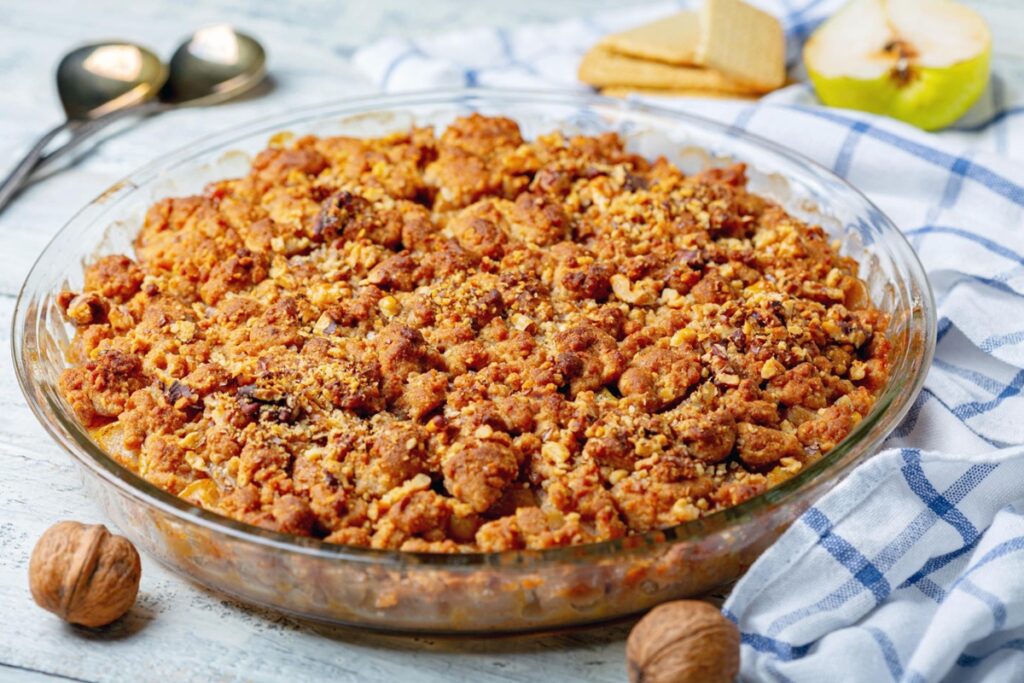
Over a dish of lemon-dashed apples and pears, distribute this sandy dough and bake at around 350 °f for 35 to 40 minutes, monitoring from the 25-minute mark since olive oil or coconut oil colors quickly.
If the top browns too much, cover with parchment paper. Your crumble keeps for 2 to 3 days in the refrigerator and pairs beautifully with fresh plant-based yogurt.