
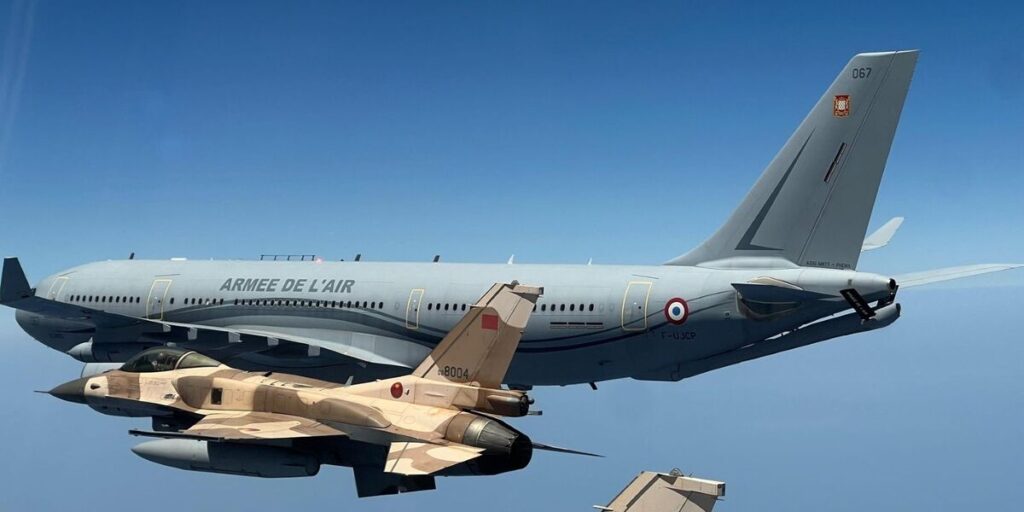
Initially, it seemed like the precursor to a diplomatic incident: Moroccan fighter jets racing to intercept a French military aircraft in their airspace. However, beneath this facade of tension lay a much different narrative—one characterized by close collaboration, precision flying, and deep-seated trust between two longstanding allies.
Unexpected interception over Moroccan skies
This week, locals along Morocco’s Atlantic coast were treated to a spectacle reminiscent of an action movie: two F-16C/D Fighting Falcons from the Royal Moroccan Air Force took to the sky to intercept what appeared to be a foreign intruder in their airspace.
The aircraft in question was identified as a French Air Force Airbus A330 MRTT Phénix, a large aerial refuelling and transport plane, escorted by two Dassault Rafale B fighter jets. Acting swiftly, the Moroccan pilots formed up and communicated with the French crew, formally “inviting” them to return to international airspace—a mere formality in standard air defence protocol.
Although the situation may sound dramatic, the reality was far more mundane: this was merely a rehearsed scenario as part of Exercise Marathon 25, a joint Franco-Moroccan military drill aimed at enhancing operational coordination between the two nations’ air forces.
Collaboration over conflict
Held annually, this exercise unites some of the most skilled aviators from both countries. This year’s iteration showcased five Rafale B fighters from France’s 4th Fighter Wing and an A330 MRTT Phénix from the 31st Strategic Air Refuelling and Transport Wing, alongside eight F-16 Fighting Falcons from the Moroccan side.
A highlight for the Moroccan pilots was the chance to practise in-flight refuelling with the advanced A330 MRTT—capabilities far superior to their standard KC-130H Hercules tankers. As one Moroccan pilot described it, “It’s like upgrading from driving a truck to operating a space shuttle.”
For the French aircrews, the exercise encompassed live-fire drills conducted within Moroccan airspace—an essential opportunity for them to operate in unfamiliar settings and assess the interoperability of both forces under real-world conditions.
Allies with a shared legacy
Despite occasional political tensions between Paris and Rabat, a robust military partnership endures between the two nations. France is one of Morocco’s key defence allies, engaging in regular joint operations, training, and intelligence-sharing.
As defence analyst Karim El-Haoud observed, “Exercises like Marathon 25 go beyond mere military exhibition—they symbolize trust. It’s uncommon for nations to grant such comprehensive access to their airspaces and strategic resources.”
Beyond a mere drill
While the staged interception might have appeared dramatic, it held significant real-world implications. The exercise evaluated both nations’ capabilities to respond to potential airspace infringements, coordinate communications under pressure, and uphold discipline in high-stakes situations.
For the public, this was a crucial reminder: what may seem like confrontation can be cooperation in disguise.
In light of this, while images of Moroccan F-16s shadowing a French Airbus may have stirred concerns of a diplomatic divide, the truth tells a different story: a showcase of shared expertise, mutual respect, and decades of partnership, continuously working to ensure the skies over North Africa and Europe remain secure.





