
When Daniel Hawkins brought home a cheeky tabby he named Muffins, he believed he was simply welcoming a new companion into the family. Little did he know, this seemingly innocent adoption would transform his nights into something resembling a suspense thriller.
A Peculiar Nocturnal Ritual
Like many heartwarming rescue tales, this one began in a local animal shelter. Daniel, his wife, and their two kids were instantly smitten with Muffins—a curious young cat sporting soft fur and a glint of mischief in his eyes. Within mere days, Muffins had made himself at home on the sofa, claimed the sunny windowsill, and, quite audaciously, settled into Daniel’s bedroom.
But before long, an unusual habit emerged. Night after night, without fail, Muffins would position himself at the bedroom doorway and gaze at Daniel for hours on end. Not curled up for a snooze. Not engaged in playful antics with shadows or chasing invisible prey. Just… staring.
Initially, Daniel found it entertaining—a quirky cat behaviour, he thought. He even tried coaxing Muffins onto the bed, hoping that a little proximity would comfort the feline. Yet, Muffins remained resolute in his unblinking attention, a silent watchman in the night.
The Nighttime Footage Experiment
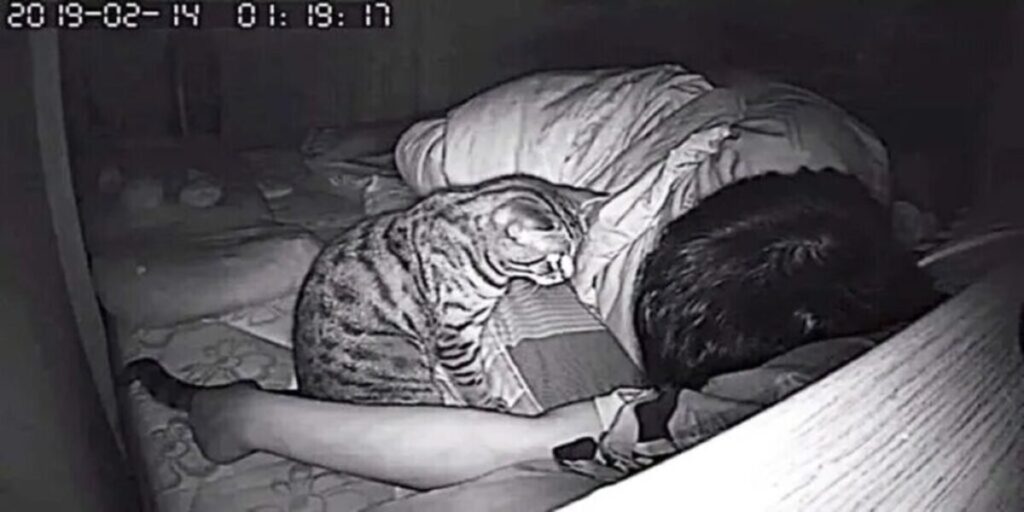
Weeks passed, and Daniel’s mild curiosity morphed into genuine concern. Determined to uncover the enigma behind Muffins’ nightly vigils, he set up a small motion-activated camera at the foot of the bed to capture the elusive night activities.
When dawn broke, Daniel poured himself a strong cup of coffee and settled down to dissect the footage. What unfolded before him left him utterly speechless.
An Alarming Revelation
The video revealed that Muffins wasn’t just observing—he was climbing onto Daniel’s face in the dead of night. For minutes on end, the cat sprawled across Daniel’s chest or even rested on his mouth, purring loudly while pressing his paws close to Daniel’s nose.
That was when the pieces finally fell into place. Daniel had been grappling with worsening asthma symptoms since Muffins’ arrival. The midnight wheezing, the morning sensations of tightness in his chest—it all suddenly made sense. According to the American Lung Association, pet dander can trigger asthma in those predisposed to it, particularly when contact is intimate. And in Daniel’s case, “intimate” meant “smothered in fur.”
Affection That’s a Bit Too Close for Comfort
Upon showing the footage to his wife, she erupted with nervous laughter, before pointing out the irony. “He’s just expressing his affection,” she noted, “though perhaps he’s being a bit too affectionate.”
Experts from the ASPCA suggest that cats often demonstrate their love through proximity, seeking warmth, familiar scents, and the rhythmic sound of their human’s breathing. To Muffins, those late-night “hugs” were pure affection; to Daniel, they posed a health risk.
Finding a Balanced Solution
Equipped with this new insight, Daniel and his family opted for a straightforward, yet effective, solution. Muffins now enjoys his own cat bed, strategically positioned near the couple’s bed, allowing him to feel close while ensuring he doesn’t get too close. They also invested in an air purifier and take extra measures to keep bedding fur-free.
It took a few nights, but soon, all were basking in a better night’s sleep—Daniel breathing easy while Muffins contentedly curled up in view of his humans.

A Lesson for Every Pet Owner
Daniel’s experience serves as a gentle reminder that our pets’ demonstrations of love sometimes require a little fine-tuning. If your cat or dog has developed an unusual evening habit—scratching, pacing, or, yes, staring—consider observing them more closely. A simple camera might reveal what words can’t.
As Daniel later reflected, “Muffins wasn’t haunting me—he was hugging me. Just in the most impractical manner imaginable.”
And that’s the essence of cohabitating with animals: they remind us that love can take unpredictable forms, even if it leaves us a bit out of breath.





