
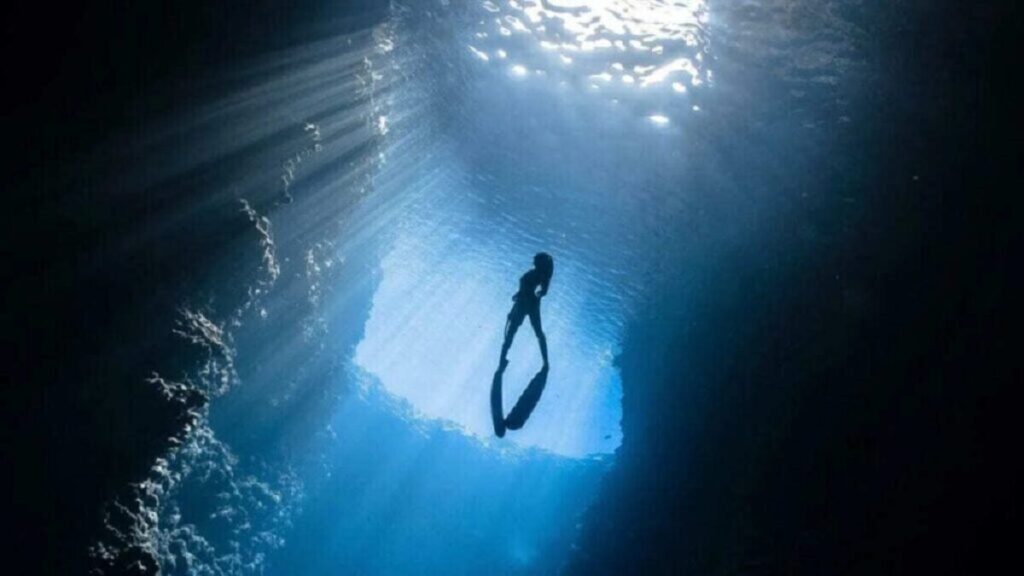
This sounds like the premise of an intriguing late-night documentary that keeps you pondering well into the night. Imagine an ocean that surpasses all surface waters combined, not hidden beneath crashing waves, but deeply embedded within the Earth itself. This is no mere hypothetical scenario; scientists are now uncovering evidence that a substantial reservoir of water lies hundreds of kilometres below us, providing a fresh perspective on Earth’s history.
Discovering Earth’s Concealed Water Supply
When we consider water on our planet, we typically envision coastlines, glaciers, and the stunning depths of oceans and seas. Rarely do we think to look downwards, beyond the crust and into the mantle. However, researchers have identified what might be referred to as a hidden ocean, encapsulated within a mineral called ringwoodite at depths of around 700 kilometres.
This underground reservoir isn’t water in the conventional sense but is locked within the rock’s mineral structure. The scale of this discovery is astonishing: scientists believe it may contain three times more water than all of the Earth’s surface oceans combined.
For many years, we were led to believe that Earth’s water likely arrived here by chance, delivered by icy comets during our planet’s formative years. This new finding offers a richer, intrinsic explanation for the origins of water on Earth.
The Science Behind the Revelation
This breakthrough stems from seismic research rather than traditional drilling or direct observation. Steven Jacobsen, a geophysicist at Northwestern University and the lead researcher, describes the finding as ‘clear evidence that Earth’s water originated from within’.
To reach this conclusion, the research team analysed data from around 2,000 seismographs distributed across the United States. These instruments recorded seismic waves from more than 500 earthquakes. Unusually slow seismic waves indicated the presence of water in certain mantle layers.
By tracking these wave patterns, scientists pinpointed zones deep in the mantle where water must exist. Their findings show that ringwoodite can retain water within its crystal structure, functioning like a sponge.
While the United States Geological Survey has historically used seismic data to map the Earth’s interior, this study has taken that method to an unprecedented level of accuracy.
Rethinking Earth’s Water Cycle
The implications of this discovery are significant. If vast quantities of water are hidden within the mantle, then Earth’s water cycle isn’t solely about rain, rivers, and evaporation. It also involves a slow and ongoing interaction between our planet’s surface and its deep interior.
Jacobsen suggests that without this deep reservoir, much of Earth’s water could have remained on the surface, potentially flooding continents and leaving only mountain peaks visible. This striking scenario underscores the crucial role of mantle geology in fostering Earth’s habitability.
Researchers are now keen to explore whether similar water-rich zones exist in other parts of the globe. If so, this would bolster the idea that this subterranean ocean is a worldwide phenomenon, rather than a localized curiosity.
A New Perspective on Our Planet
This discovery serves as a humbling reminder that, despite centuries of exploration, Earth still harbours profound secrets. What lies beneath our feet can be just as enigmatic as the vast expanse of space.
For scientists, this hidden ocean may help explain the stability of surface ocean volumes over millions of years. For the rest of us, it compels a reevaluation of Earth’s water origins.
So, the next time you stand by the sea, remember that far below, deep within the mantle, another ocean may quietly be influencing the planet—a world we are only beginning to delve into.





