
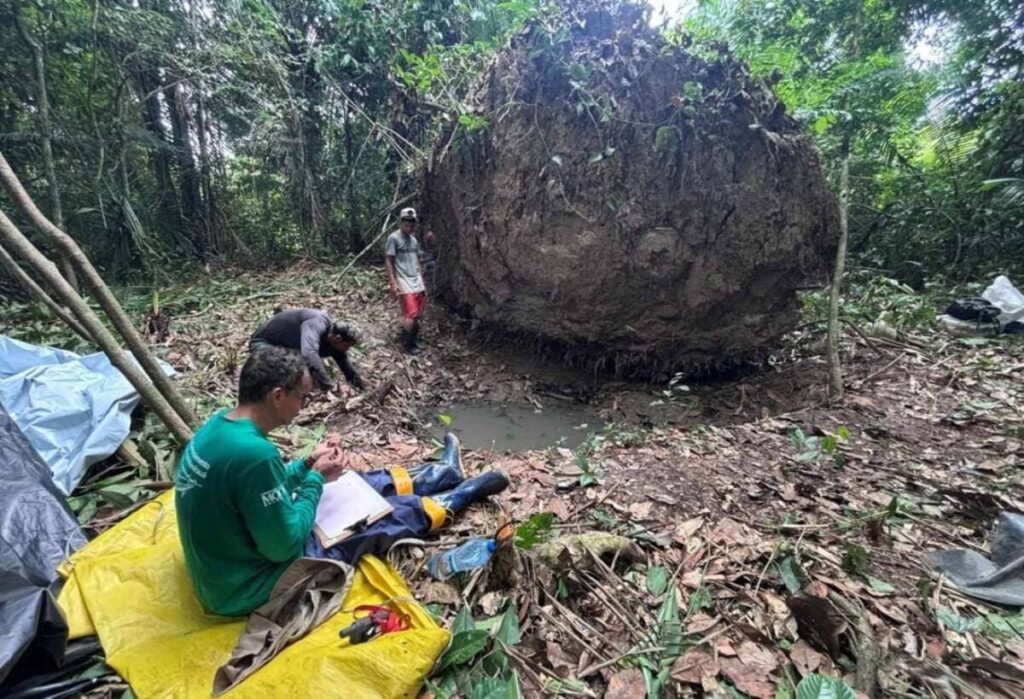
Occasionally, a groundbreaking discovery arises that compels scientists to reevaluate their understanding of an entire region. This moment has recently unfolded deep within the Amazon rainforest, where the roots of a fallen tree revealed remnants of a long-lost civilization. The ensuing expedition—by boat, canoe, and foot through thick forest—uncovered remarkable ceramics, unlike anything documented before. These urns represent more than mere artifacts; they serve as portals to a society where engineering, ritual, and daily life were intricately intertwined, offering insights we are only beginning to grasp.
Serendipitous Discovery Among Tree Roots
The tale commenced in early 2025, when locals from São Lázaro do Arumandubinha stumbled upon two substantial ceramic vessels nestled beneath the roots of an uprooted tree. Recognising the significance of the find, a community fishery manager contacted the local priest, who subsequently notified researchers at the Mamirauá Institute. This led to an archaeological team embarking on a demanding journey to the Lago do Cochila site in the Fonte Boa region.
What they unearthed was beyond their highest expectations: seven massive funerary urns, some tipping the scales at over 300 kilos, resting just below the surface. Initial examinations revealed fragments of human bones alongside remnants of fish and turtles. These discoveries point to intricate funerary practices involving both burial and offerings—rituals that are seldom preserved in Amazon’s floodplains.
Ingenious Indigenous Engineering on Artificial Islands
This site is part of an extensive network of ancient artificial islands built across the region’s periodically flooded plains. Constructed from layers of soil and broken pottery, these elevated platforms allowed historical communities to thrive, farm, and engage socially even during seasonal inundations. Archaeologist Márcio Amaral describes these structures as evidence of advanced Indigenous engineering, challenging traditional views about the capabilities of Amazonian populations.
The urns were likely interred beneath the floors of ancient dwellings, reinforcing the notion that these floodplains hosted permanent settlements rather than temporary encampments. Their intriguing design—made of greenish clay adorned with red slips—belongs to a cultural tradition not yet documented elsewhere in the area, hinting that archaeologists might be encountering a completely unique cultural group.
A Collaborative Excavation Shaped by Science and Community
This project stands out not only for its archaeological significance but also for the collaboration between researchers and local residents. Community members played a crucial role at every phase of the excavation: from clearing the forest to constructing elevated wooden structures and meticulously transporting the hefty urns downriver. Archaeologist Geórgea Layla Holanda reported that no aspect was improvised; layers of plaster, bubble wrap, and wooden supports were employed to ensure the fragile artifacts reached the lab unscathed.
Researchers highlight that this collaboration transcends mere logistical support. It epitomises a model of community-led conservation, where scientific expertise and local knowledge synergize. Amaral notes that archaeology in the Amazon is increasingly shifting “from the inside out,” driven by the insights and stewardship of the local populace.
An Ongoing Narrative
The urns are currently undergoing detailed analysis at the Mamirauá Institute. Scientists are hopeful to conduct carbon dating—pending funding—to ascertain whether these relics date back 500, 1,000, or potentially over 3,000 years. Regardless of their exact age, this discovery is already transforming our comprehension of ancient Amazonia, a region characterised by innovation, spiritual richness, and enduring settlement rather than pristine wilderness.
For the descendants of these early societies, this discovery signifies more than an academic benchmark; it affirms that their ancestors intentionally shaped the landscape with care, skill, and rich cultural depth. Hidden for centuries beneath the forest floor, these urns are beginning to communicate their stories once more—and their narrative is only just beginning.





