
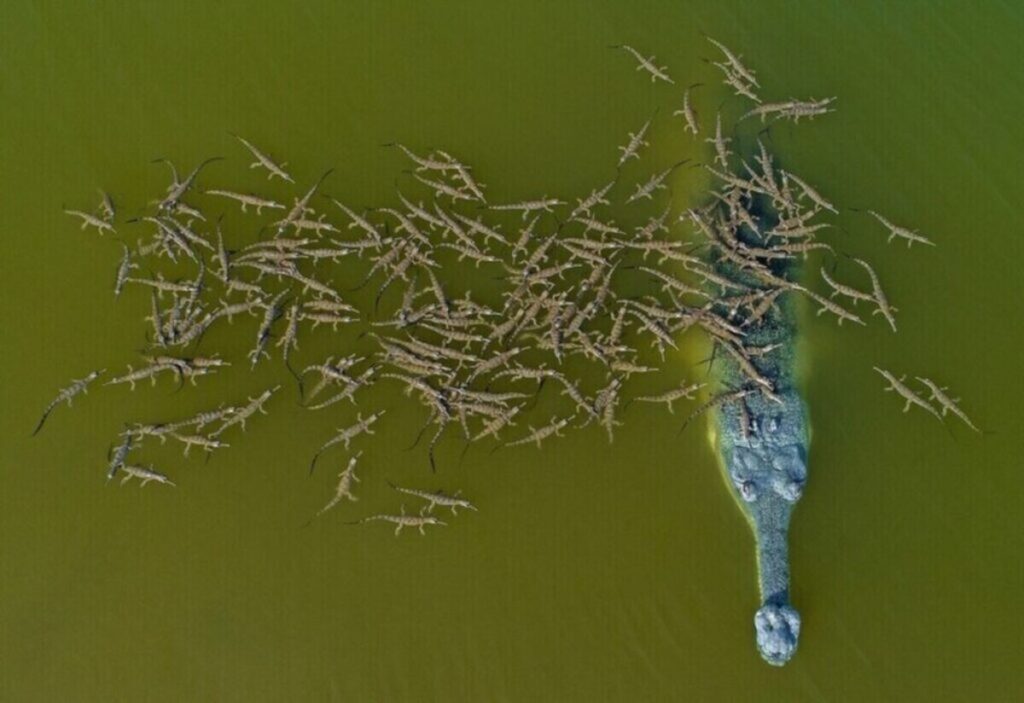
Some wildlife photographs are compelling enough to halt our scrolling, while others leave us in a state of wide-eyed astonishment. A remarkable image currently captivating the internet falls squarely in the latter category: a colossal crocodile gracefully navigating a sacred river, with a swarm of tiny hatchlings clinging to its back. It’s the sort of moment that feels almost legendary, yet unfolds within one of the planet’s most delicate ecosystems.
A rare sight in a revered river
This extraordinary photograph was taken by Dhritiman Mukherjee, a renowned wildlife photographer celebrated for his careful approach and profound respect for the creatures he captures. In northern India, he dedicated weeks to patiently wait in a protected river sanctuary for an elusive glimpse of the critically endangered gharial—an easily recognizable crocodilian species known for its elongated, narrow snout.
The enchanting backdrop is the Ganges, a river deeply revered for both its spiritual significance and its rich biodiversity. Within its waters dwell gharials, whose distinctive physiology prohibits them from carrying their young as other crocodilians do. Instead, the males exhibit a surprisingly tender parenting technique: ferrying their hatchlings on their backs, providing a secure vantage point from which to navigate swift currents and evade predators.
Such behaviour is a rare sighting, let alone documented with such clarity. The gharial featured in Mukherjee’s image is believed to be nurturing several clutches of hatchlings, explaining the nearly 100 tiny gharials that appear to clamber across its colossal back.
The role of fathers in gharial society
While male gharials may not typically be seen as doting parents, this nurturing instinct is essential for the species’ survival. With just about 650 adults remaining in the wild, every juvenile counts. Patrick Campbell, senior reptile curator at the Natural History Museum, notes that habitat destruction and deteriorating river health have placed the gharial perilously close to extinction. Fully grown, these impressive creatures can reach over four metres in length and weigh nearly a tonne, but their strength pales in the face of human-induced environmental changes.
The Chambal River, home to India’s largest gharial population, is where approximately 500 individuals continue the struggle for survival. Successful breeding seasons have turned into treasured milestones in conservation efforts. Moments like the one captured in this photograph serve as beacons of hope—a visual testament to endurance amid a world rife with challenges.
Capturing the essence of the river
Mukherjee’s photograph does more than document a unique animal behaviour; it encapsulates the emotional heartbeat of a river that has nourished both communities and wildlife for centuries. Maintaining a respectful distance, he wielded his lens to bring the world closer to a species that many may not be familiar with, let alone witness in such a close-up moment.
This image has already made the shortlist for the prestigious Wildlife Photographer of the Year competition, receiving high praise in a contest hosted by the Natural History Museum. Amid thousands of entries, it distinguished itself not only through technical excellence but also through the compelling narrative it conveys about survival, adaptation, and the quiet heroism residing in the unlikeliest of places in nature.

Highlighting what’s at stake
As someone who dedicates a considerable amount of time to collecting stories from around the globe, this tale strikes a chord. It serves as a powerful reminder that the natural world does not merely persist; it adapts, surprises, and thrives when given the opportunity.
In an era when conservation issues loom large, images like this prompt us to take a moment to reflect. They inspire us to consider our individual roles in protecting vulnerable ecosystems and the species that inhabit them. Witnessing a father gharial transporting a living, wriggling flotilla of his young is not just heartwarming; it represents a testament to resilience, familial bonds, and the incredible beauty that continues to exist in the wild.
Sometimes, all it takes is one exceptional photograph to encourage the world to look a little more closely.





