
China is once again tightening its grip on the upper echelons of its military establishment, as a new corruption investigation implicates some of its senior-most officers. Notably, one of the highest-ranking generals in the People’s Liberation Army (PLA) has come under scrutiny. This development is a continuation of a long-standing campaign that has altered the Chinese political landscape and bolstered Xi Jinping’s hold over the armed forces. However, it raises important questions: Why is this happening now, and what does it reveal about the current state of China’s military?
A High-Profile General Disappears
A key figure in this investigation is General He Weidong, who until recently wielded considerable power within the military hierarchy. As vice-chairman of the Central Military Commission (CMC) — the organization overseeing China’s armed forces — he was ranked just below Xi Jinping himself.
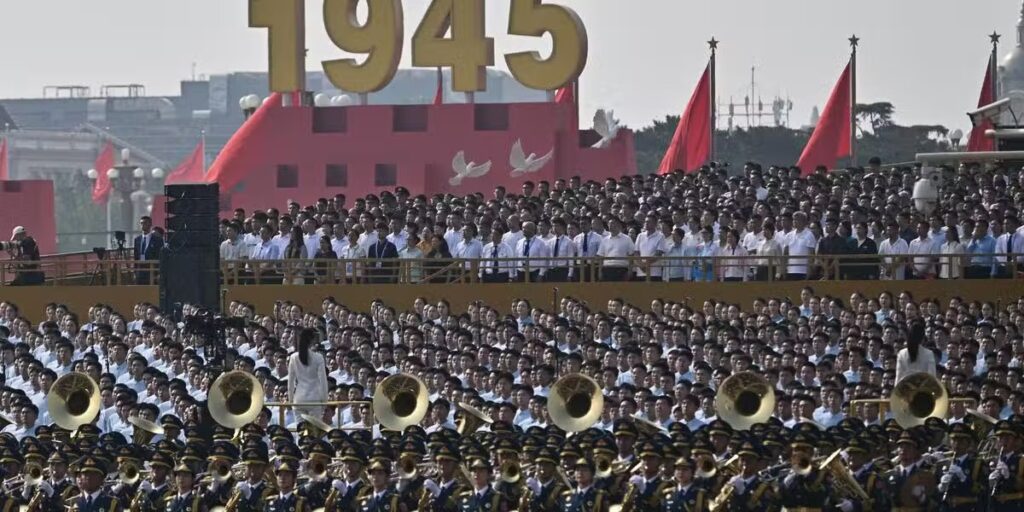
However, He has been absent from public view for several months, most notably missing from the significant military parade in Beijing on September 3, commemorating the end of World War II in Asia. His absence did not go unnoticed, raising suspicions among analysts and diplomats keeping a close eye on China’s elite.
For the first time, the Chinese government has confirmed his downfall. Defense Ministry spokesperson Zhang Xiaogang announced that nine senior officers are being investigated by the CMC’s discipline inspectors, with He Weidong at the forefront. In China, such public confirmation typically signifies that an individual has been politically erased.
Xi Jinping’s Anti-Corruption Campaign Targets the Military
Since ascending to power in 2012, Xi Jinping has enacted what state media describes as an “unprecedented” anti-corruption campaign. The Central Commission for Discipline Inspection has expelled hundreds of high-ranking officials across the government, the Communist Party, and particularly within the military.
The Chinese government frames this initiative as crucial for combating corruption and ensuring loyalty within the armed forces. Corruption has long plagued the PLA, with scandals involving procurement fraud, pay-for-promotion schemes, and the misuse of military land. Research from organizations such as the Carnegie Endowment for International Peace has underscored how corruption undermines operational preparedness and strategic modernization.
However, critics contend that this purge also serves a political agenda: removing potential rivals and solidifying Xi’s personal command over a military that is increasingly vital to China’s global ambitions.
The Significance of This Moment
General He Weidong’s ousting is noteworthy not only due to his rank but also because of the timing. As China accelerates military modernization, heightens tensions in the South China Sea, and intensifies its strategic rivalry with the United States, any significant upheaval at the top raises concerns of internal instability during a precarious period.
This dismissal comes on the heels of several sudden removals in the aerospace and missile sectors, including commanders associated with China’s nuclear capabilities, sparking further speculation about deeper issues within the PLA.
As Beijing strives to develop what Xi has termed a “world-class military” by mid-century, the leadership appears keen to eradicate behaviors it perceives as disloyal, ineffective, or politically hazardous.
A Purge with Global Consequences
Global attention intensifies whenever China reorganizes its military leadership behind closed doors. The U.S. Department of Defense has consistently emphasized the importance of understanding internal PLA dynamics to thoroughly assess China’s strategic direction.
This latest purge follows a familiar pattern: sweeping changes at the uppermost levels, limited transparency, and robust messages of discipline directed at the ranks. However, it remains uncertain how pervasive the underlying issues are — and whether this signals the culmination of the cleanup process or the start of another wave of purges.
For the time being, one thing is clear: China’s military is undergoing a significant internal transformation, and the repercussions may extend well beyond Beijing.





