
What began as an ordinary drive through Tasmania’s Ben Lomond National Park—a locale known for its meandering roads, enveloping fog, and the occasional wallaby—turned into an extraordinary wildlife experience for Richard Waldron and Shannon Lee, two members of the Tasmanian Rover Ski Club.
An Unexpected Encounter
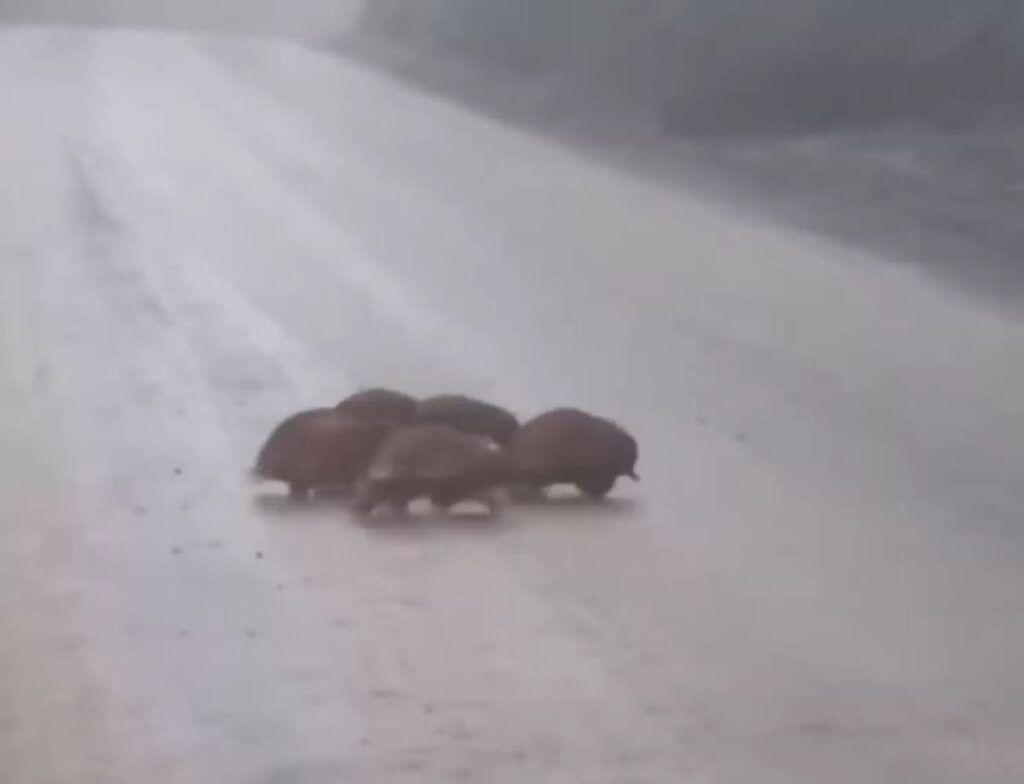
As their vehicle ascended a mountain road engulfed in thick fog, the duo was abruptly compelled to stop. From the dense mist emerged five small, spiny beings—not the wallabies they expected, but rather echidnas, more colloquially referred to as spiny anteaters.
“We both just froze for a moment,” Waldron recounted later. “It felt surreal to see them calmly traversing the road right in front of us.”
Echidnas are notoriously elusive, solitary creatures found across Australia, Tasmania, and parts of New Guinea. Usually, they go about their business alone, relying on their impressive camouflage and spiky skin to avoid detection. However, what Waldron and Lee witnessed was anything but ordinary. The five echidnas appeared to be forming a mating train, a rare spectacle where multiple males pursue a single female in hopes of securing her attention.
A Rare Sight Caught on Camera
Fortunately for wildlife enthusiasts everywhere, Waldron and Lee managed to record the moment on video before the echidnas vanished back into the fog. When they later shared the footage online, it quickly garnered attention, accumulating thousands of views and enthusiastic comments from people across the globe.
“We had no idea how unusual it was until people started responding,” Lee explained. “Most locals told us they’ve only ever spotted one or two echidnas at a time—never five together.”
Experts from the Australian Museum note that such behavior typically occurs during the cooler months when echidnas enter their breeding season. Spotting such a phenomenon in the wild, however, is exceedingly rare due to their reclusive nature.
Nature’s Living Oddities
Echidnas are among the most fascinating and ancient members of the mammal family. Together with the platypus, they belong to a unique group of egg-laying mammals known as monotremes. Equipped with sharp spines for defense, elongated snouts for foraging, and strong claws for digging, these creatures are intriguingly well-adapted.
Despite their robust appearance, echidnas are gentle and slow-moving, making them particularly susceptible to traffic hazards. This vulnerability prompts local conservationists to emphasize the necessity of driving cautiously in wildlife-rich areas, particularly in Tasmania, where narrow roads and fog can obscure the presence of animals.
A Reminder to Share the Road
Following the viral success of the video, environmental organizations and tourism bodies lauded Waldron and Lee for their quick thinking and respectful approach. Visit Northern Tasmania even shared the clip, noting, “A perfect reminder to take it easy on our roads—we share this land with remarkable wildlife.”
The Tasmanian Department of Natural Resources continually encourages drivers to remain vigilant for nocturnal or slow-moving animals, especially in national parks home to species like echidnas, wombats, and wallabies. Unfortunately, every year, numerous native animals fall victim to road-related accidents—a statistic conservationists hope to change through increased awareness.

Nature’s Surprises Are Everywhere
For Waldron and Lee, this encounter served as a profound reminder of nature’s unpredictability. What began as a foggy drive transformed into an unforgettable glimpse of one of Australia’s most enigmatic animals.
“It made us appreciate how fortunate we are to live in a place like this,” Waldron reflected. “You truly never know what lies just beyond the mist.”
Whether one is trekking through the highlands of Tasmania or simply strolling through a local park, nature rewards those who are observant. Slow down, keep a lookout, and you just might uncover a moment of wonder—one that remains etched in your memory long after the fog has lifted.





