
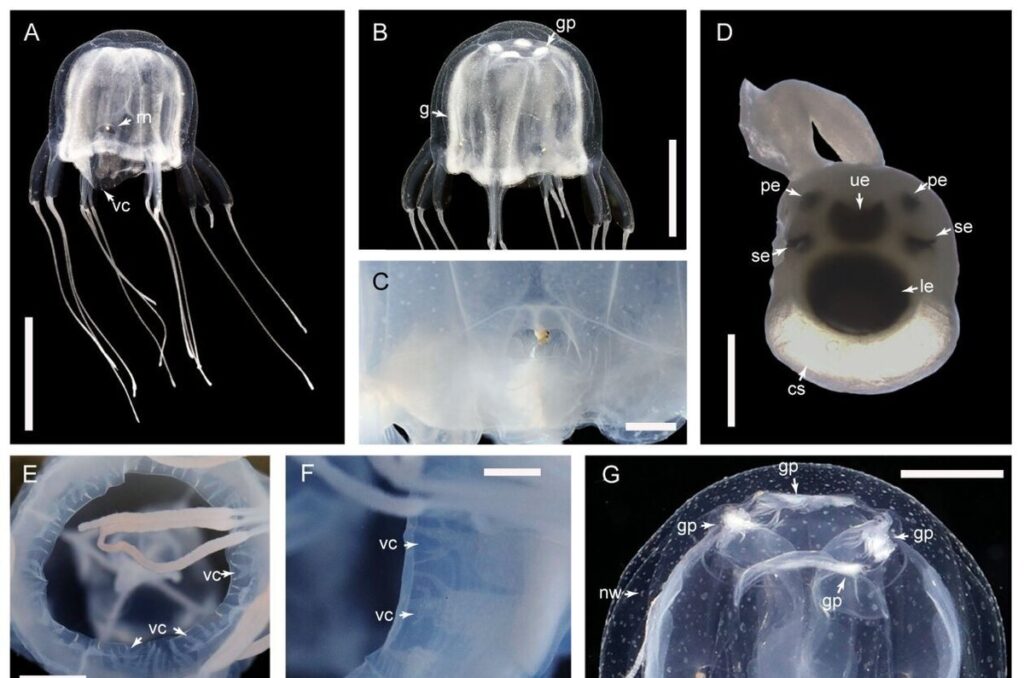
It’s not every day that a standard water quality assessment transforms into an episode straight out of a wildlife documentary. Yet, that’s precisely what occurred in Hong Kong, where a team of researchers unexpectedly encountered a diminutive, venomous jellyfish—remarkably square in shape and boasting an incredible 24 eyes.
A box-shaped marvel in murky waters
During an examination of water quality in a serene, green-tinted pond at the Mai Po Nature Reserve, scientists cast a net expecting to retrieve common finds like algae or perhaps a few tadpoles. To their astonishment, they hauled up a nearly invisible jellyfish, measuring under a centimeter with a cubic body adorned with eyes on every side.
And this jellyfish wasn’t just sporting a few eyes—24 in total, arranged in clusters of six. Of these, two in each cluster can form images, while the rest are specialists at detecting changes in light. It’s as though nature gifted this minuscule creature a built-in surveillance array.
Introducing Tripedalia maipoensis
This remarkable discovery was not just unique—it was entirely new to science. Genetic and physical examinations confirmed that this was a previously undiscovered species of box jellyfish, which researchers have aptly named Tripedalia maipoensis, paying tribute to the Mai Po region.
If you think the term “box jellyfish” sounds familiar, you’re onto something. This category encompasses some of the most venomous marine organisms on Earth. Though this new species is petite, its biology is no less fascinating. It’s also quite fast, employing paddle-like structures attached to its tentacles to dart through the water with unexpected agility.
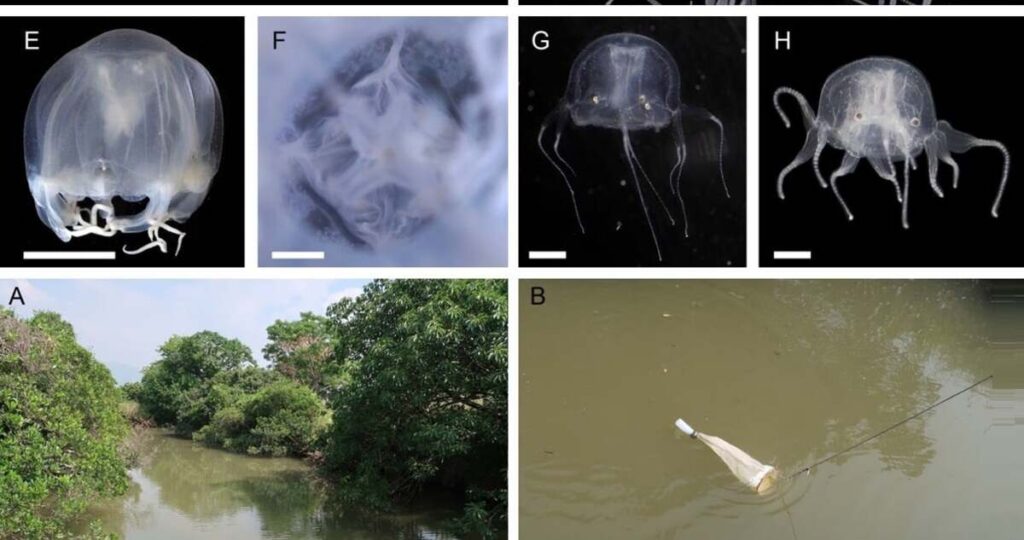
This species features four corners, each sprouting three elongated tentacles, resulting in a total of twelve. Combined with its eye clusters and sleek, translucent physique, Tripedalia maipoensis appears to be a marvel of nature, designed for speed and sensory acuity.
A first for Chinese waters
This marks the inaugural identification of a box jellyfish within Chinese waters, a significant milestone. Marine biologists emphasize that such discoveries underscore how much remains unexplored in the aquatic environments of this area.
Beyond its novelty, this diminutive jellyfish could offer insights into biodiversity shifts, particularly as climate change continues to impose its effects on marine ecosystems. It serves as a potent reminder that even the tiniest of organisms can create substantial ripples in scientific understanding.
The significance of this discovery
While it’s easy to be captivated by the jellyfish’s 24 eyes and intriguing name, the true impact lies in what this discovery reveals about the hidden world beneath the waves. The oceans—indeed, even tranquil ponds—hold countless undiscovered species, many of which possess unique characteristics that could expand our knowledge of evolution, adaptation, and survival.
So, the next time you find yourself near a quiet pond, take a moment to look around. You never know what tiny, translucent marvels might be observing you in return.





