
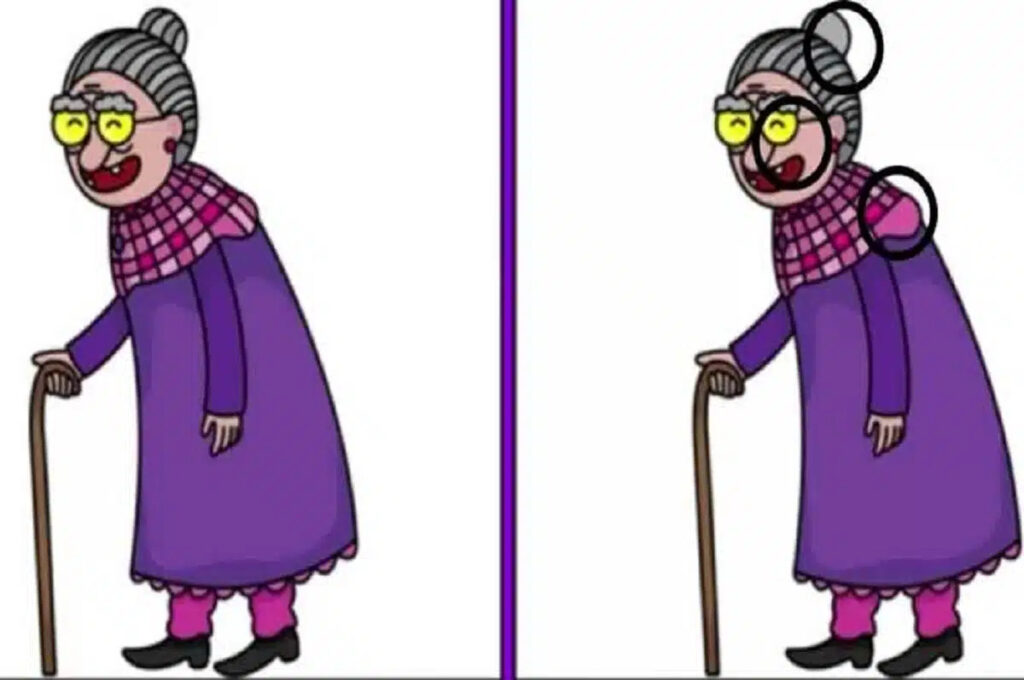
Having keen eyesight goes beyond merely seeing things clearly. It’s about honing in on the minutiae that often escape notice. For those willing to take on a challenge, here’s a fun puzzle designed to engage both your mind and your vision.
The Challenge
Initially, the two images appear to be identical: a delightful grandmother donning a purple dress, a cane in hand, and stylish glasses resting on her nose. But don’t let appearances fool you — there are three subtle differences cleverly disguised within.
Your task? Identify all three differences without giving up. It sounds simple, but don’t underestimate it. Even those who pride themselves on their attention to detail can find this puzzler quite tricky. Focus is crucial here; unlike many spot-the-difference challenges, this one doesn’t impose a timer — the difficulty level is already set high.
Did You Spot Them?
If you successfully identified all three differences, well done! You’ve showcased your eagle eye and sharp observational skills. But before you celebrate, here’s the official rundown of where those elusive differences are hidden:
- First up, take a closer look at the bun in grandma’s hair — one version has a slight variation.
- Next, examine her shawl; the pattern differs just a tad.
- Lastly, the trickiest one: a wrinkle beneath her glasses that’s absent in one of the images.
Why These Puzzles Matter
While they might seem like just light-hearted fun, puzzles like these offer benefits beyond mere enjoyment. Cognitive researchers assert that visual games can enhance attention, bolster memory, and condition the brain to quickly identify details. In fact, engaging in regular mental exercises is believed to contribute to long-term brain health.
Conclusion
So, did you uncover all three differences? Whether you sailed through or required a second glance, keep in mind that observation is a skill that can be refined. Continue challenging yourself with these visual puzzles, and soon enough you’ll find yourself catching nuances that most people would typically overlook. Ultimately, it’s not just about having good eyesight — it’s about taking the time to look closely.





